What Is PCG? Premier Card Grading for SA Collectors
By Mitchell Taljaard · · Updated
PSA is the name most collectors know, and we compare the two in our PCG vs PSA guide. PCG is newer, and South African collectors often ask us who PCG is before they send their cards.
We're Cuppas Cards, a PCG submission service for South African Pokémon collectors. We don't grade cards ourselves: PCG assigns every grade. This guide covers who PCG is, how it grades, and how to check a PCG slab.
Who is Premier Card Grading?
Premier Card Grading is a third-party card grading and authentication company. It was founded in Auckland, New Zealand, in 2021 by Matt Rogers, a Flesh and Blood veteran (Star City Games, July 2022).
PCG now lists regional offices in Australia, England, Germany, Japan, Malaysia, New Zealand, the Philippines and the United States (PCG FAQ). The company is registered in New Zealand. Our South African cards go to PCG in the UK.
PCG was also chosen to grade official prize cards for the Flesh and Blood trading card game. In 2022, Flesh and Blood announced that Calling and Pro Tour champion prize cards would be graded by PCG at 9.5 or better. The first event was the Calling Singapore in August 2022 (Star City Games, July 2022).
What does PCG UK offer?
PCG UK offers four trading card services, priced per card in pounds (PCG UK pricing):
| Service | Price | Turnaround | Notes |
|---|---|---|---|
| Standard | £15 | 4 to 6 weeks | Subgrades and metal labels |
| Bulk | £12 | 8 to 10 weeks | 50 cards or more |
| Express | £25 | 5 to 7 days | Drop-off in the UK, so not available through us |
| Authentication | £10 | 2 to 4 weeks | Confirms the card is real, with no grade |
Cuppas Cards uses the £15 Standard service, so every card comes back with its subgrades printed on the label. Through us, that £15 grading fee works out to R325. Our service price is R495 per card, including the DHL trip to the UK and back. Customs, insurance, postage to us and delivery back are extra, and our cost breakdown itemises each one.
The 4 to 6 weeks is PCG's published time for direct submissions. As a PCG partner, our batches are promised about 30 days at PCG. From South Africa, we expect slabs back about 40 days after a batch ships, and our first batch is still out.
How does PCG grade a card?
PCG looks at four subgrades: centering, corners, edges and surface (PCG FAQ). Each one gets its own score.
The final grade isn't a straight average of the four. PCG weighs some flaws more heavily than others, because some affect a card's eye appeal more (PCG FAQ). For example, a card with three perfect subgrades and one weak one can land lower than a simple average would suggest.
Centering is measured as a ratio, front and back. A perfectly centred card has equal borders on each side, written as 50/50.
What does each PCG grade mean?
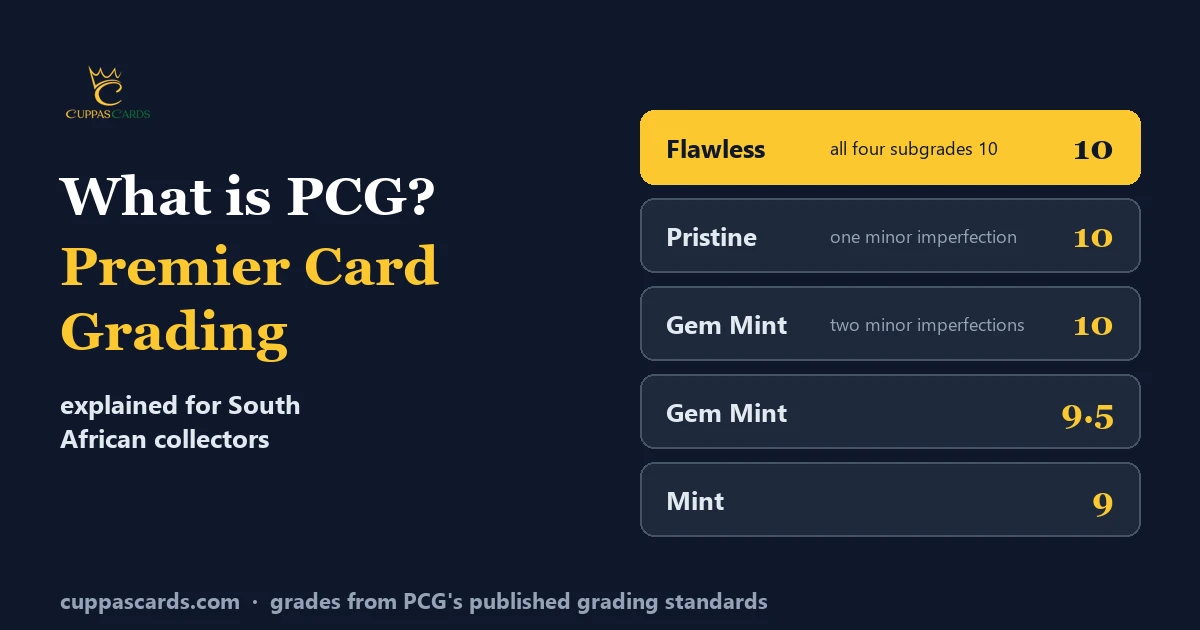
PCG grades from 1 to 10, with half grades near the top. The table below summarises PCG's published grading standards (PCG grading standards).
| Grade | What it means | Front centering |
|---|---|---|
| 10 Flawless | 10 on all four subgrades, no visible defects | 50/50 |
| 10 Pristine | One minor visible imperfection in one subgrade | 50/50 |
| 10 Gem Mint | Minor visible imperfections in two subgrades | 50/50 to 55/45 |
| 9.5 Gem Mint | Just short of Pristine 10 eye appeal | 50/50 one way, 55/45 the other |
| 9 Mint | A few minor imperfections across subgrades | 55/45 or better |
| 8.5 NM-Mint+ | Just short of Mint 9 | 60/40 |
| 8 NM-Mint | Slight wear, such as minor corner or edge wear | 60/40 or 65/35 |
| 7.5 Near Mint+ | Just short of NM-Mint 8 | 65/35 |
| 7 Near Mint | Slight imperfections that affect eye appeal | 65/35 or 70/30 |
| 6 Excellent | Noticeable imperfections in several areas | 70/30 |
| 5 Good | Slight wear and noticeable imperfections | 80/20 |
| 4 Fair | Moderate wear visible to the naked eye | 80/20 |
| 3 Worn | Significant visible wear | 85/15 |
| 2 Poor | Significant, easily visible damage | 90/10 |
| 1 Damaged | Excessive damage | No requirement |
What's the difference between the three 10s?
PCG splits the top grade three ways, and the difference is how many subgrades show any flaw. Flawless 10 needs a perfect 10 on all four subgrades. Pristine 10 allows one minor imperfection in one subgrade. Gem Mint 10 allows minor imperfections in two.
That split matters because it tells a buyer more than a single "10" would. Our guide to what card grades mean shows how PCG's names line up with PSA, CGC, TAG and Beckett. A Gem Mint 10 and a Pristine 10 can look the same at a glance, but the Pristine has been judged closer to perfect.
What labels can a PCG slab have?
A regular PCG label shows the grade and, on the Standard tier we use, all four subgrades. PCG also uses special labels (PCG grading standards):
- Flawless 10: a 24K gold-coated, engraved metal label, PCG's highest grade
- Special event: commemorative labels for cards submitted at or for an event
- Authentication: confirms the card is genuine, with no grade or subgrades
- Error: marks significant printing mistakes, such as misprints or miscuts
- Altered or counterfeit: marks cards that have been modified or faked
How can you check a PCG slab?
Look up the certificate number on PCG's population report. It shows the card's details and how many copies of that card PCG has graded at each grade. PCG's app also offers the population report and order tracking (PCG FAQ).
Check that the card, grade and subgrades on the report match the slab in front of you. A matching cert is a good first check before you buy, not a guarantee. Our guide to checking a PCG cert shows each step, and our guide to buying graded slabs covers the other checks.
Why does Cuppas Cards use PCG?
We chose PCG for two reasons: faster turnaround and subgrades.
PCG's Standard service quotes 4 to 6 weeks to grade, and our partner batches are promised about 30 days. PSA's cheapest open tier quotes 90 to 100 business days (Sports Illustrated Collectibles, September 2026). And every Standard slab shows four printed subgrades, so you can see exactly where your card scored well and where it lost points.
For the full cost and resale comparison, read our PCG vs PSA guide or our PCG vs CGC comparison. To see PCG next to PSA, CGC, TAG and Beckett at once, read our guide to choosing a card grading company from South Africa.
Frequently Asked Questions
Is PCG a real grading company?
Yes. Premier Card Grading has graded cards since 2021, runs regional offices including England, and was chosen to grade official Flesh and Blood champion prize cards. Each slab's cert number can be looked up on PCG's population report.
Does PCG give subgrades?
Yes. PCG scores centering, corners, edges and surface on every card. On the £15 Standard tier we use, all four are printed on the label.
Where does PCG grade South African cards?
Cards sent through Cuppas Cards go to PCG in the UK. PCG itself is registered in New Zealand, with offices in several countries.
How do I send cards to PCG from South Africa?
Submit them through Cuppas Cards, post them to us in Swellendam, and we ship them to PCG UK in a pooled batch. Our step-by-step grading guide covers the whole process, and our cost breakdown shows every rand.
What to read next
Before you send anything, our pre-grading checklist helps you spot flaws and pick the cards most likely to grade well. Our shipping and packing guide then shows how to protect them on the way to us. One card per order is fine when you're ready to submit.
PCG prices and grading standards as published on 19 October 2026.