Buying Graded Pokémon Slabs in South Africa: What to Check
By Mitchell Taljaard · · Updated
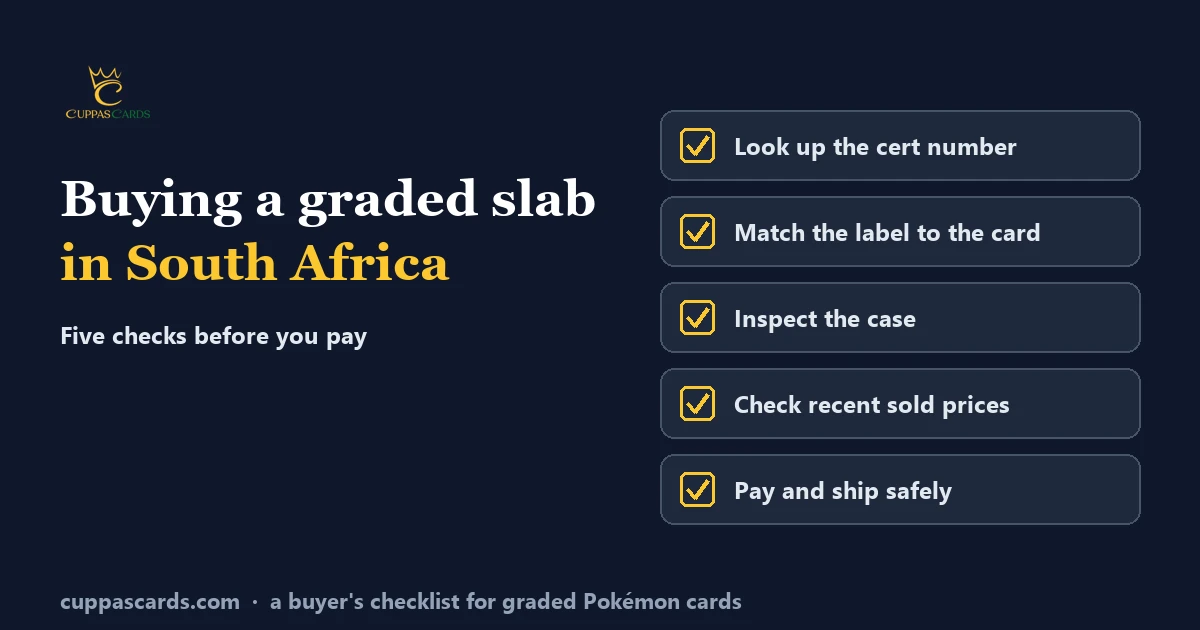
A graded slab should mean you know exactly what you're buying. But slabs can be faked, opened and resealed, or sold for far more than they're worth. A few minutes of checking protects you from all three.
We're Cuppas Cards, a PCG submission service for South African Pokémon collectors, and we sell PCG graded slabs at our event booth. We don't grade cards ourselves: PCG assigns every grade. These are the checks we'd run on any slab, whoever sells it.
| Check | What should match | Red flag |
|---|---|---|
| Cert number | Card, set and grade on the grader's database | Number not found |
| Label | Name, number, grade and subgrades | Details that differ from the card or database |
| Case | Clean, even seams and a snug card | Frosted seams, gaps, a card that doesn't fit |
| Price | Recent sold prices for the same grade and grader | Far below market |
| Payment and delivery | Protected payment, insured or in-person handover | Instant transfer to a stranger |
Step 1: Look up the cert number
Every graded slab has a certificate number on its label. Look it up on the grader's own database before you pay. For PCG slabs, use PCG's population report. PSA and CGC have their own cert lookup pages on their official websites.
The lookup should show the same card, set and grade as the slab in your hand. If the number returns nothing, walk away. Our guide to checking a PCG cert walks through PCG's report field by field.
A match isn't proof on its own, though. Scammers copy real cert numbers from genuine slabs onto fake labels (Misprint, July 2026). That's why the next checks matter.
Step 2: Check the label against the card
Read the label line by line and compare it with the card inside. The card name, set, card number and grade should all match the database and the card itself.
On PCG's Standard-tier slabs, the label shows the grade and four subgrades: centering, corners, edges and surface (PCG FAQ). PCG's Player's Slab puts the card details on the back instead (PCG). PCG also colour-codes its labels. Gem Mint 9.5 and 10 labels are gold, and authentication-only labels are silver with no grade. Our guide to PCG labels and grades explains each one.
Only PCG's Player's Slab carries an NFC chip (PCG). Standard-tier slabs don't have one, so a missing chip on a Standard slab isn't a warning sign. If a Player's Slab has a chip, compare what it shows with the label and the cert lookup. PCG doesn't publish a chip check of its own, so the cert lookup remains your main check.
Step 3: Inspect the case
Look closely at the plastic case, especially the edges where the two halves meet. Misprint lists these warning signs (Misprint):
- Hazy "frosting" along the edges of the case
- Gaps or uneven seams where the halves meet
- A card slightly oversized or undersized for its holder, which can mean the card was swapped
- Label print that looks heavier than normal, with letters too tightly spaced
We'd add one more: a card that moves around inside the case deserves a closer look.
If you can, compare the slab with one you know is genuine from the same grader. Fakes are easier to spot side by side.
Step 4: Check the price
Look up recent sold prices for the same card, in the same grade, from the same grader. On eBay, for example, the "Sold items" filter shows what buyers actually paid, not what sellers hope for. Many sold listings are in dollars or pounds, so convert them to rand at today's rate before you compare. PCG sales are rarer than PSA ones, so you may need to widen the search to nearby grades or recent months.
Be careful with deals that look too good. Misprint calls a high-grade chase card listed well below market "the single most common bait for slab fraud" (Misprint).
The grader matters to price too. PSA slabs usually sell for more than the same grade from other graders. Our PCG vs PSA comparison explains the gap and when it matters.
Step 5: Pay and ship safely
Buying in person is the safest option, because you can handle the slab and run every check before you pay. At collector shows, you can compare several slabs side by side.
If you buy online:
- Ask for clear photos of the front, back and seams, and of the label up close. Walk away if the seller won't send them.
- Use a payment method with buyer protection, such as a card payment or a marketplace's own checkout. Avoid paying strangers by instant transfer.
- Insure the delivery. Pudo's cover is capped at R1,500, so a valuable slab needs extra cover or in-person collection.
Buying from an overseas seller?
A slab shipped from abroad can attract customs duty and VAT when it arrives in South Africa, on top of international shipping. Add those costs before you compare an overseas price with a local one. Our cost breakdown shows how duty and VAT add up on graded cards.
Where can you buy PCG slabs from Cuppas Cards?
We sell PCG graded Pokémon slabs at our booth at collector shows in Cape Town. Buying in person means you can check every slab yourself before you pay. Read more about us, or get in touch to ask what we'll have at the next show.
Frequently Asked Questions
Does a valid cert number mean a slab is real?
No. It's the first check, not the last. Fake slabs can carry a real cert number copied from a genuine slab, so the card, label and case all need to match too.
How do I check a PCG slab?
Look up its cert number on PCG's population report. Then check the card, grade and subgrades on the label match the database and the card inside.
Is it safer to buy slabs in person?
Yes. You can handle the slab, check the seams and label, and look up the cert number on your phone before you pay.
Can I get a raw card graded instead of buying a slab?
Yes. If you already own the card, grading it can cost less than buying the slab. Our cost breakdown shows the full rand figures.
Checks and courier cover as of 19 October 2026.