What Do Card Grades Mean? The 1 to 10 Scale Explained
By Mitchell Taljaard ·
When a grader returns your card, the number on the label is a judgement of its physical condition. It doesn't measure rarity or price. It tells a buyer how close the card is to perfect, using the grader's published standards.
We're Cuppas Cards, a PCG submission service for South African Pokémon collectors. We don't grade cards ourselves: PCG (Premier Card Grading) assigns every grade. This guide explains what the 1 to 10 scale means at the main graders, using each one's own published standards.
What do graders check on a card?
Graders judge four things: centering, corners, edges and surface. PCG and Beckett print each one on the label as a subgrade.
Beckett's grading page describes what each one means (Beckett grading):
- Centering. How evenly the image sits within the card's borders. It's written as a ratio, so 50/50 is perfectly centred and 60/40 means one border is wider.
- Corners. They should be free of dings, creases, bends or discolouration.
- Edges. They should be crisp, with no fraying, chipping or dings.
- Surface. Front and back should be free of stains, smudges and scratches. Print defects, such as ink smears, also count against the card.
Graders check the back of the card as well as the front. PSA and CGC both allow looser centering on the back for a Gem Mint 10: up to about 75/25.
If you want to check a card yourself before you send it, our pre-grading checklist walks through all four.
What does each grade from 1 to 10 mean?
Names and definitions differ by grader. This table uses PSA's published definitions as one example (PSA grading standards). PCG's scale is different: its "Good" is a 5, while PSA's is a 2.
| Grade | PSA name | What it means |
|---|---|---|
| 10 | Gem Mint | A virtually perfect card: four sharp corners, sharp focus, full original gloss |
| 9 | Mint | Superb condition, with only one minor flaw |
| 8 | NM-MT | Looks Mint at first glance, with slight flaws on closer inspection |
| 7 | NM | Slight surface wear visible on close inspection; corners may fray slightly |
| 6 | EX-MT | Visible surface wear or a printing defect |
| 5 | EX | Very minor rounding of the corners is becoming visible |
| 4 | VG-EX | Corners may be slightly rounded, with surface wear |
| 3 | VG | Some rounding of the corners |
| 2 | Good | Accelerated rounding of the corners and surface wear |
| 1.5 | Fair | Corners show extreme wear |
| 1 | Poor | Many of the same qualities as a 1.5, but worse |
At PSA, 7 and 8 show slight flaws on close inspection. From 6 down, wear or defects are visible. A Gem Mint 10 also needs front centering of about 55/45 or better.
What are half grades?
A half grade, such as an 8.5, marks a card that sits at the top of its grade. Each grader uses them a little differently:
- PSA gives half points between 2 and 9 for high-end cards, with "a clear focus on centering" (PSA grading standards).
- CGC uses half grades from 1.5 to 9.5 (CGC grading scale).
- Beckett grades in half points across its whole 1 to 10 scale (Beckett grading).
- TAG uses half points everywhere except between 9 and 10, so it has no 9.5 (TAG grading scale).
- PCG uses half grades near the top, such as 7.5, 8.5 and 9.5 (PCG grading standards).
Why does "Gem Mint" mean different things at different graders?
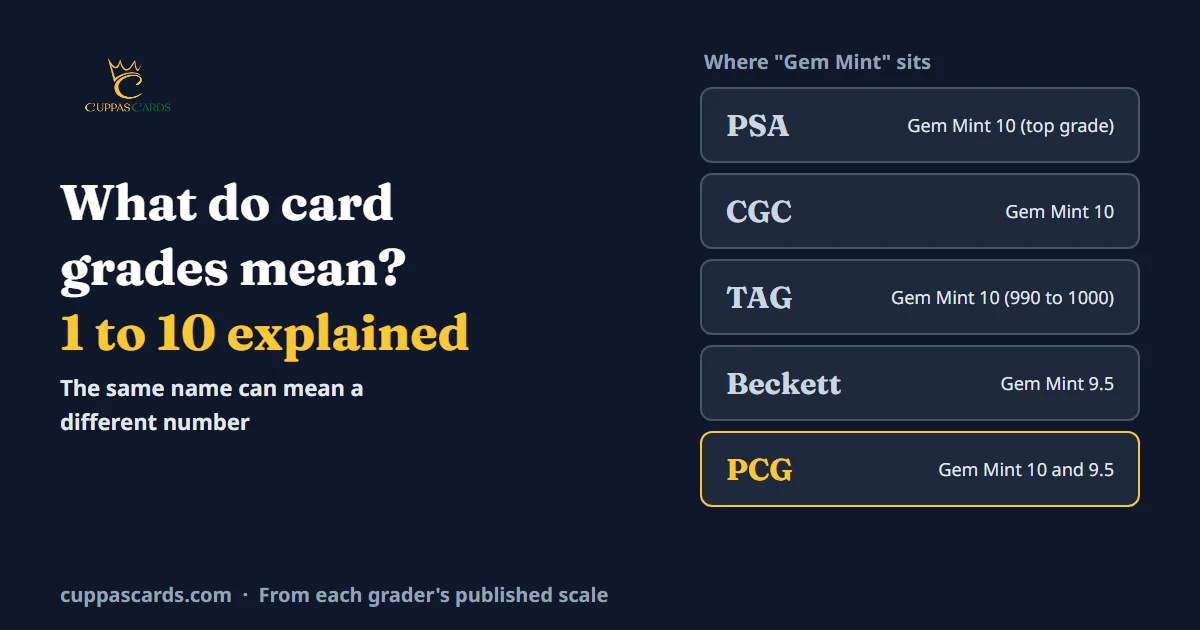
Because each grader names its own scale. The same words can sit at different numbers.
| Grader | "Gem Mint" grade | Its grade above Gem Mint |
|---|---|---|
| PSA | 10 | None; Gem Mint 10 is PSA's top grade |
| CGC | 10 | Pristine 10 |
| TAG | 10 (a score of 990 to 1000) | Pristine 10 |
| Beckett | 9.5 | Pristine 10, with Black Label for a perfect Pristine |
| PCG | 10 and 9.5 | Pristine 10, then Flawless 10 |
Sources: PSA, CGC, TAG, Beckett and PCG.
So "Gem Mint" on its own doesn't tell you the number. A Beckett Gem Mint is a 9.5, while a PSA Gem Mint is a 10. When you compare listings, read the grader and the number, not just the name.
A 10 isn't the same everywhere either. PSA's Gem Mint 10 is its highest grade. PCG's Gem Mint 10 is its third level of 10, below Pristine 10 and Flawless 10.
How do subgrades become one final grade?
PCG doesn't simply average its four subgrades. It says it weighs some flaws more heavily than others, because some affect a card's eye appeal more (PCG FAQ).
That's why a card with three perfect subgrades and one weak one can land lower than a straight average suggests.
PCG prints all four subgrades on its Standard-tier labels (PCG UK pricing), so you can see exactly where a card lost points. Our guide to PCG grades shows PCG's full scale, with the centering limit for each grade.
What does "Authentic" mean on a slab?
An "Authentic" label means the grader confirms the card is genuine, but gives it no number.
- PSA uses Authentic when a card is genuine but can't be graded, for example because of an alteration or a major defect. "Altered Authentic" marks a genuine card that has been altered (PSA grading standards).
- CGC uses Authentic for genuine, unaltered cards that can't get a number, and Authentic Altered for cards that have been trimmed or recoloured (CGC grading scale).
- PCG offers an authentication-only service, which confirms the card is real without giving a grade (PCG UK pricing).
An Authentic or Altered label isn't a low grade. It means the card was confirmed genuine without a number, either because it couldn't be graded or because only authentication was ordered.
Frequently asked questions
Is a PSA 9 a good grade?
Yes. PSA describes a Mint 9 as a superb condition card with only one minor flaw. Only a 10 sits above it on PSA's scale.
Is a PSA 10 the same as a PCG 10?
Not exactly. PSA's Gem Mint 10 is its top grade. PCG has three 10s: Flawless, Pristine and Gem Mint. Read the full label, not just the number.
What does NM-MT mean?
Near Mint-Mint. At PSA it's an 8: a card that looks Mint at first glance but shows slight flaws on closer inspection.
Can I predict what grade my card will get?
Only roughly. You can check centering, corners, edges and surface at home, but the grader makes the final call. Our pre-grading checklist shows how.
Choosing a grader
Grade names are one thing to compare. Cost, turnaround and resale are others. Our guide to choosing a card grading company from South Africa compares all five graders. Our PSA resale guide covers whether a PSA slab really sells for more. When you're ready, submit your cards for PCG grading.