Does a PSA Slab Really Sell for More? Resale Value Explained
By Mitchell Taljaard · · Updated
Maybe you've been told "just use PSA, it holds its value." It's partly right. PSA slabs do tend to sell for more. But how much more is far less certain than the advice suggests, and the extra cost of PSA from South Africa is much easier to pin down.
We're Cuppas Cards, a PCG submission service for South African Pokémon collectors. We don't grade cards ourselves: PCG assigns every grade. So we have a side in this. Below, we show what the published estimates say and where they disagree. Then we give a simple way to work out whether PSA is worth it for a particular card.
How much more does a PSA slab sell for?
We haven't found a reliable, independent answer. The estimates we found all come from collector price guides, and they disagree widely.
| Source | What it estimates | Date |
|---|---|---|
| PokemonPriceTracker | Modern PSA 10: 5% to 10% over a CGC 10. Vintage: 20% to 30% | April 2026 |
| PreGradeCards | PSA 10: 10% to 30% over a CGC 10 | September 2026 |
| The Card Shop Finder | Cites an August 2026 PokemonPriceTracker comparison: 25% to 60% on modern chase cards | Updated October 2026 |
PokemonPriceTracker also puts a modern Beckett 9.5 at 10% to 15% below a PSA 10, and a vintage one at 15% to 25% below.
None of these sources explains how it calculated its figures. None gives a sample size, a date range or the sales it used. The Card Shop Finder reports a higher August figure from the same publisher, 25% to 60%, but only for modern chase cards.
So the honest answer is that PSA 10s usually sell for more, by an amount that depends on the card and on who you ask.
Why do PSA slabs sell for more?
PokemonPriceTracker gives three reasons: brand recognition, liquidity and population data (PokemonPriceTracker).
- Brand recognition. PokemonPriceTracker calls PSA's the strongest brand among collectors and investors.
- Liquidity. PokemonPriceTracker says PSA slabs typically sell fastest.
- Population data. It says PSA has the largest population database, so buyers can see how many copies exist at each grade.
The same source says vintage collectors strongly prefer PSA, and it estimates a bigger gap for older cards.
None of this says a PSA 10 is a better card than another grader's 10. The premium is about demand for the slab, not the condition of the card inside it.
What about PCG, TAG and Beckett slabs?
We haven't found reliable public sales data comparing PSA with PCG or TAG slabs. Every estimate above compares PSA with CGC, plus one with Beckett.
That matters for South African collectors weighing PSA against PCG. We can't tell you PCG slabs sell at the same discount to PSA as CGC slabs do. They might sell at a bigger discount. If they do, PSA's premium over PCG is larger than the figures above, and PSA pays off on cheaper cards than our numbers below suggest.
We'd rather say that plainly than guess. If you're grading mainly to sell, check sold prices for your exact card in each slab before you choose.
What does PSA cost from South Africa compared with PCG?
PSA costs at least R742 more per card than PCG through Cuppas Cards, and that's before PSA's shipping and any middleman fee.
| Route | Grading fee | With estimated import charges | Still to add |
|---|---|---|---|
| PCG through us, £15 Standard | R495 including the UK round trip | About R593 | Insurance, postage to us, delivery back |
| PSA, $59.99 Standard | About R990 | About R1,335 | Shipping to PSA and back, insurance, any middleman fee |
PSA paused its four cheapest Value tiers on 2 June 2026 (ICv2, 29 May 2026). Its $59.99 Standard tier is now its cheapest open tier (Sports Illustrated Collectibles, 9 September 2026). We convert it at R16.46 to the dollar (Trading Economics, 19 October 2026). Import charges are our estimate of 20% duty plus 15% VAT, the same method we use for our own pricing.
R1,335 minus R593 is R742. That gap is the minimum extra PSA costs per card. Shipping to PSA and back, or a middleman's fee, makes it bigger. Our PCG vs PSA guide and cost breakdown break both routes down further.
When does PSA's premium pay for itself?
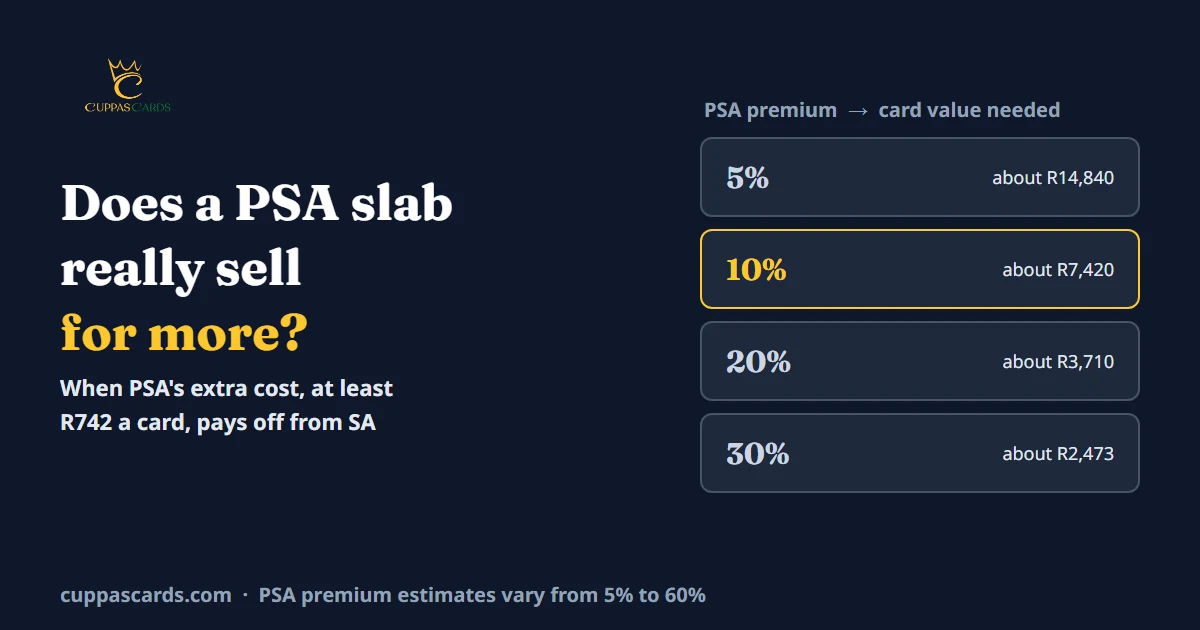
PSA pays off when the extra sale price beats its extra cost. With a R742 gap, the card's graded value has to be large enough for the premium to cover it.
The sum is simple: divide PSA's extra cost by the premium. At a 10% premium, R742 divided by 0.10 is R7,420.
| PSA premium | Graded value where the premium covers R742 |
|---|---|
| 5% | About R14,840 |
| 10% | About R7,420 |
| 20% | About R3,710 |
| 30% | About R2,473 |
"Graded value" here means what the card would sell for in the other slab. Below that value, the premium doesn't cover PSA's extra fees. Above it, PSA starts to make sense, if you plan to sell.
Four things move these numbers:
- Shipping and middleman fees raise PSA's extra cost, which pushes the break-even higher.
- A bigger premium over PCG than over CGC would push the break-even lower.
- Selling fees take a cut of the higher sale price, so the premium you keep is smaller than the headline figure.
- The grade you get. These estimates are for 10s. If your card comes back a 9, the premium and the card's value both change.
So a R500 card almost never justifies PSA on resale alone. A R20,000 card often might.
Does any of this matter if you're not selling?
No. The resale premium only matters when you sell.
If you're grading cards for your own collection, the premium never reaches you. What matters then is cost, waiting time and what the slab shows you. PCG's Standard tier, which we use, prints four subgrades on the label, so you can see exactly where your card scored. Our guide to PCG grades explains them.
You can split the difference: send the one valuable card you plan to sell to PSA, and grade the rest more cheaply.
How can you check resale prices for your card?
Look up recent sales of your exact card, in the exact grade, in each grader's slab. Asking prices tell you little; sold prices tell you what buyers actually paid.
- Search the card on eBay and filter to sold listings.
- Compare the same grade across graders, such as PSA 10 against CGC 10 and PCG 10.
- Note how many sales there are. One or two sales can't show a pattern.
- Check the population reports, which show how many copies each grader has graded. PCG's population report is open to everyone. PSA's population report on psacard.com asks you to sign in.
If you can't find sales of your card in a PCG slab, that's useful to know too. A card with few comparable sales is harder to price when you sell it.
Our guide to buying graded slabs covers how to check a slab's cert before you buy.
Frequently asked questions
Do PSA 10s always sell for more than CGC 10s?
Usually, but not always. Price guides estimate the PSA premium at anywhere from 5% to 60%, and none publishes its method. Check sold prices for your specific card.
Is PSA worth it for cheaper cards?
Rarely, from South Africa. PSA costs at least R742 more per card than PCG through us. At a 10% premium, a card needs to be worth about R7,420 before the premium covers that.
Do PCG slabs hold their value?
We don't know yet. We haven't found reliable public sales data for PCG slabs, so we won't claim they sell at any particular price against PSA.
Can Cuppas Cards send my cards to PSA?
No. We only send cards to PCG in the UK.
Choosing where to grade
For PCG, PSA, CGC, TAG and Beckett side by side, read our guide to choosing a card grading company from South Africa. When you're ready, add your cards on our submission page, and pack each one in a semi-rigid holder.
Prices as published on 19 October 2026.