Pokémon Error Cards: Famous Misprints and What They Sold For
By Mitchell Taljaard · · Updated
Every few months a "rare misprint" Pokémon card goes viral online. Some are real collector pieces. Many are ordinary cards with a print flaw, and a few are fakes. This guide sorts the famous ones by what they actually are and shows what real copies have sold for.
We're Cuppas Cards, a PCG submission service for South African Pokémon collectors. We don't grade cards ourselves: PCG (Premier Card Grading) in the UK assigns every grade. All prices are as of 21 October 2026. Every price below is a past sale, not today's value, and none of this is investment advice. Rand figures use R16.41 per US$ (Trading Economics, 20 October 2026), so they show what the old sale would be in today's rands.
What counts as a Pokémon error card?
A Pokémon error card is a card printed with a mistake that wasn't meant to be there. But collectors use "error" loosely. It helps to split the famous cards into four groups.
| Group | What it means | Example |
|---|---|---|
| True factory error | A mistake printed on many copies, often fixed later in the print run | Jungle "No Symbol" holos |
| Print variant | Two official versions of the same card, both made on purpose or both accepted | Red Cheeks Pikachu |
| First print | An early print run that differs from later runs | Japanese "No Rarity" Charizard |
| Test print | A prototype or sample made before the real release | Blastoise test prints |
There's also a fifth thing people call a misprint: a one-off flaw. Think a miscut, an ink smudge or a blurry print. These happen to single cards, not whole runs. They're usually treated as damage, not as a collectable error.
Which Pokémon error cards are the most famous?
These are the misprint Pokémon cards collectors talk about most. Each one has a sale record below, with the grade, date and venue.
Red Cheeks Pikachu (Base Set #58)
Type: print variant, often sold as an error.
Base Set Pikachu came with red cheeks or yellow cheeks in 1st Edition and Shadowless. Unlimited copies only have yellow cheeks (Fanatics Collect). Collectors still argue about whether red cheeks count as a true error.
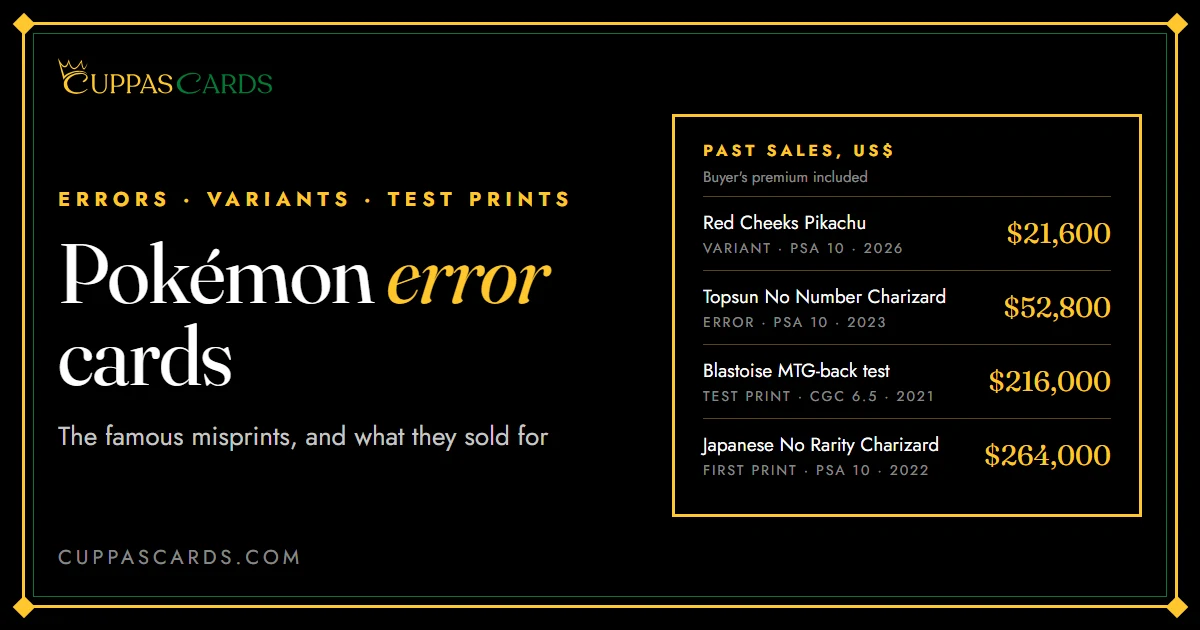
A Shadowless 1st Edition PSA 10 sold for $29,400 (about R482,000) including buyer's premium after 48 bids on 19 June 2026 (Fanatics Collect, June 2026). Another Shadowless 1st Edition PSA 10 sold for $21,600 (about R354,000) including buyer's premium on 24 July 2026 (Fanatics Collect, July 2026).
That's a 27% drop in five weeks for the same card in the same grade. Both listings put the Red Cheeks PSA 10 population at about 260 copies. Prices on famous variants can swing a lot.
Jungle "No Symbol" holos (1999 Unlimited)
Type: true factory error.
Some 1999 Unlimited Jungle holos were printed without the Jungle set symbol, the small flower at the bottom right of the art box. That's where the "No Symbol" name comes from. These are Unlimited cards from the Wizards of the Coast era, not 1st Edition, and only the 16 holo rares come this way (T206 Cards checklist).
This is a good reminder that a true error isn't always worth a fortune. Scyther #10 in PSA 9 (population 382) has these sales on Fanatics Collect:
| Sale date | Price (USD) | About (ZAR) |
|---|---|---|
| 6 June 2022 | $138 | R2,260 |
| 27 June 2022 | $132 | R2,170 |
| 11 March 2024 | $110.40 | R1,810 |
| 1 June 2026 | $204 | R3,350 |
| 18 October 2026 | $699 | R11,470 |
The October 2026 sale is far above the others. One sale could be an outlier, so don't read it as a trend.
Japanese Topsun Charizard, Blue Back "No Number" (1997)
Type: true factory error.
Topsun made Pokémon gum cards in Japan. Some blue-back Charizard cards were printed without the Pokédex number on the front. (For the main TCG card, see our Base Set Charizard guide.) The error was quickly corrected, but many "No Number" cards still reached circulation (Fanatics Collect).
A PSA 10 "No Number" copy sold for $52,800 (about R866,000) including buyer's premium on 20 January 2023 (Fanatics Collect, January 2023). PSA had graded only three copies at 10 at the time.
You'll also see a bigger number quoted. A PSA 10 Topsun Blue Back Charizard sold for $493,230 (about R8.1 million) at Goldin in January 2021 (Wikipedia). We can't confirm that copy was a "No Number" card, so don't treat the two sales as the same card.
1996 Japanese Base Set "No Rarity" Charizard
Type: first print, not an error.
The first Japanese Base Set print run left out the rarity symbol in the bottom right corner. Later runs added it. So this card isn't a mistake. It's an early version.
A PSA 10 sold for $264,000 (about R4.33 million) at Heritage on 23 to 24 September 2022. That price included buyer's premium, after 40 bids (Antiques and the Arts Weekly, September 2022). At the time, only eight PSA 10s existed. The English 1st Edition Charizard had 121.
Blastoise test prints (1998)
Type: test print, not an error.
These are prototypes made before the English cards launched. One is a Blastoise Test Print with a Magic: The Gathering back. A CGC 6.5 copy sold for $216,000 (about R3.54 million) including buyer's premium at Heritage on 7 November 2021. Six copies have been authenticated (CGC, November 2021).
The other is a blank-back "Commissioned Presentation" Blastoise, one of only two made. It sold for $360,000 (about R5.9 million) at Heritage on 14 January 2021 (NME, January 2021).
Pokémon error cards at a glance
| Card | Type | How to spot it | Sale record (past sale) |
|---|---|---|---|
| Red Cheeks Pikachu, Base Set #58 | Print variant | Red cheeks on a 1st Edition or Shadowless copy | PSA 10, $21,600 (about R354,000), Fanatics, July 2026 |
| Jungle "No Symbol" Scyther #10 | True factory error | No Jungle set symbol on a 1999 Unlimited holo | PSA 9, $204 (about R3,350), Fanatics, June 2026; one later sale at $699, October 2026 |
| Topsun Blue Back Charizard "No Number" | True factory error | No Pokédex number on the front | PSA 10, $52,800 (about R866,000), Fanatics, January 2023 |
| Japanese Base Set "No Rarity" Charizard | First print | No rarity symbol bottom right | PSA 10, $264,000 (about R4.33 million), Heritage, September 2022 |
| Blastoise Test Print, MTG back | Test print | Magic: The Gathering back | CGC 6.5, $216,000 (about R3.54 million), Heritage, November 2021 |
| Blastoise "Commissioned Presentation" | Test print | Blank back | Grade not stated, $360,000 (about R5.9 million), Heritage, January 2021 |
Prices above include buyer's premium where the source says so. They're past sales, not current values.
Do graders recognise Pokémon error cards?
Not always. Graders recognise some errors and variants on the label, but not every one. A card that looks odd to you might just get a normal grade, or a lower one.
One-off flaws can also earn a qualifier. PSA's qualifiers include OC (off-centre), ST (staining), PD (print defect) and OF (out of focus). There's also MK (marks) and MC (miscut, an atypical factory cut) (Pre-War Cards, July 2019). A qualifier marks a defect. It doesn't add value.
What about PCG? We haven't confirmed how PCG labels errors or variants, so ask us before sending one. That way you'll know what to expect on the label before you pay.
Is it a misprint or a fake?
Check before you get excited. Fake cards are common, and fake slabs exist too. A few simple checks help (Wargamer):
- Compare it with a genuine copy. Put it next to a real card from the same set and look for differences.
- Check the text. Fonts and fine print should be sharp, not blurry or the wrong shape.
- Try a light test. Shine a torch through it and compare with a real card.
- Verify any slab. Look up the cert number on the grader's website.
Don't write a card off just because the art is off-centre. That can be a genuine misprint. It just usually isn't a valuable one.
If you're buying a graded error card locally, our guide to checking graded slabs before you buy in South Africa covers what to look for. For PCG slabs, here's how to check a PCG cert and population report.
Is your error card worth grading from South Africa?
It depends on what kind of "error" you have. A known variant or factory error in good shape may be worth it. A miscut or print smudge usually isn't, because graders tend to treat it as a flaw.
Start by checking condition, since corners, edges and surface still matter. Our guide on how to pre-grade Pokémon cards walks you through it. It also helps to know what each card grade from 1 to 10 means.
Then weigh the cost. From South Africa, PCG Standard grading through us is R593 per card plus 3% insurance (R495 service including PCG's £15 fee and DHL both ways, plus about R98 customs and VAT). Our full breakdown of grading costs from South Africa has the details.
No one can promise a grade or a profit. If a card is only worth a few hundred rand raw, grading costs may be more than any gain.
FAQ
Are misprint Pokémon cards worth more?
Usually not. Only a handful of famous errors and variants sell for big money. Most one-off misprints, like miscuts or ink marks, are treated as defects and can lower a grade.
What's the difference between an error and a variant?
An error is a mistake, often corrected later in the print run. A variant is a second official version of a card, like Red Cheeks Pikachu. Collectors sometimes still debate which label fits.
Should I send my error card to PCG?
Ask us first. We haven't confirmed how PCG labels errors or variants, so we'll find out for you before you send one.
Got a card you think is special? Start a submission with us and we'll help you work out the next step.