WotC Pokémon Cards: Why 1999 to 2003 Cards Are Different
By Mitchell Taljaard · · Updated
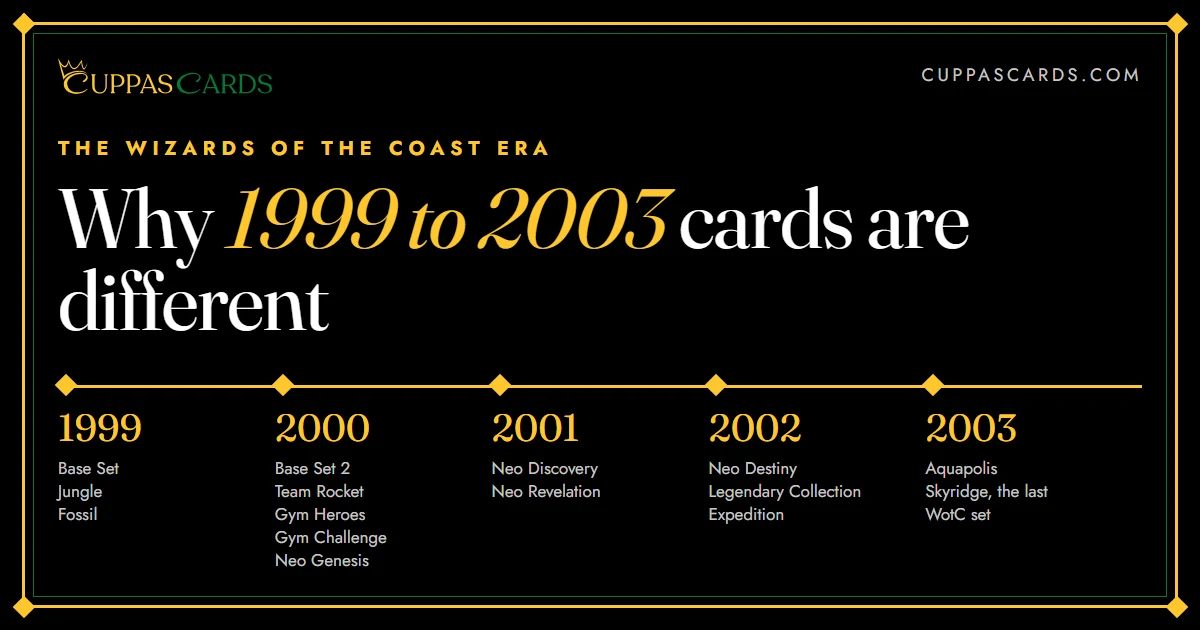
If you've ever pulled an old Charizard out of a shoebox, you've probably held a WotC card. These are the cards that started the craze, and they still drive the vintage market today. This guide covers every WotC set, how Wizards lost the licence, how to spot the special prints and what the big cards have sold for.
We're Cuppas Cards, a PCG submission service for South African Pokémon collectors. We don't grade cards ourselves: PCG (Premier Card Grading) in the UK assigns every grade. All prices are as of 21 October 2026. Every price below is a past or reported sale, not a promise of today's value. Rand conversions use R16.41 per US$ (Trading Economics, 20 October 2026).
What was the Wizards of the Coast era?
The WotC era is the stretch when Wizards of the Coast printed English Pokémon cards. According to Wikipedia, WotC published the game from December 1998 to mid-2003. The US Base Set came out on 9 January 1999.
Pokémon soon mattered a lot to Wizards' business. In September 1999, Hasbro bought Wizards of the Coast for $325 million, a deal tied to the strength of the Pokémon licence.
Every WotC set, 1999 to 2003
Here's every English WotC set, with release dates and card counts from Wikipedia's list of Pokémon TCG sets. Where the source doesn't give a figure, we've left it as "n/a".
| Set | Release date | Cards |
|---|---|---|
| Base Set | 9 January 1999 | 102 |
| Jungle | 16 June 1999 | 64 |
| Fossil | 10 October 1999 | 62 |
| Base Set 2 | 24 February 2000 | 130 |
| Team Rocket | 24 April 2000 | n/a |
| Gym Heroes | 14 August 2000 | 132 |
| Gym Challenge | 16 October 2000 | 132 |
| Neo Genesis | December 2000 | 111 |
| Neo Discovery | June 2001 | 75 |
| Southern Islands (promo set) | n/a | 18 |
| Neo Revelation | October 2001 | 64 |
| Neo Destiny | February 2002 | 105 plus 8 secret Shining cards |
| Legendary Collection | May 2002 | 110 |
| Expedition | September 2002 | 165 |
| Aquapolis | January 2003 | 186 |
| Skyridge | 12 May 2003 | 182 |
Skyridge was the last WotC set. The next English set, EX Ruby & Sapphire, came from Pokémon USA instead (Wikipedia).
How did the Pokémon card craze start?
It started fast, much faster than Wizards expected. Kotaku reported in November 2011 that WotC sold more than 400,000 packs in the first six weeks in the US. That was about 10 times Wizards' own forecast.
The numbers kept climbing. By the end of 1999, more than 1 million packs had sold, according to the same Kotaku piece. That first wave of Base Set, Jungle and Fossil is why so many people still have a binder of these cards somewhere. We compare it with later waves in Pokémon card booms compared.
Why did Wizards lose the Pokémon licence?
Nintendo wanted the US licence back. In 2001 it set up Pokémon USA to win back the US licensing rights (Wikipedia). From there, the split played out over about two years.
Here's the timeline, from Kotaku's 2011 history:
- 2002: two senior WotC executives and other staff moved to Pokémon USA.
- September 2003: Pokémon USA's own cards reached stores.
- 30 September 2003: WotC's original contract ended.
- 1 October 2003: WotC sued, alleging Pokémon USA used patented methods and knowledge from former Wizards staff.
- December 2003: the two sides announced a settlement. The terms weren't made public.
Wikipedia also notes the settlement. After Skyridge, the next English set came from Pokémon USA, so WotC cards are a closed chapter.
What makes WotC cards look different?
A few print details set WotC cards apart. Most of these come from collector knowledge rather than an official source, so treat them as a guide and check a trusted reference before buying.
The 1st Edition stamp
Collectors generally say 1st Edition WotC cards carry a small black "Edition 1" stamp on the front. Cards from later print runs, called Unlimited, don't have it.
Shadowless vs Unlimited Base Set
Early Base Set cards are known as "shadowless". The usual rule is that these lack the drop shadow on the right of the art box. They also tend to have thinner HP text. Later Unlimited prints added the shadow, so it's one of the first things to check on an old Base Set card.
Reverse holos and the later sets
Legendary Collection is widely described as the first English set with reverse holo cards. Collectors also often group the last three sets, Expedition, Aquapolis and Skyridge, as the "e-Card" sets. They look quite different from the early Base Set style.
Skyridge is widely considered the scarcest WotC set. The usual explanation is that it had only one print run before the licence ended. That's a community view, not an official print figure.
Why is it so hard to get a 10 on a WotC card?
Top grades on WotC cards are rare. The clearest example is 1st Edition Neo Genesis Lugia. PSA has graded more than 6,400 of them, and only 45 got a PSA 10, about 0.7% (Misprint, June 2026). A Fanatics Collect lot page from August 2026 shows the same PSA 10 population of 45.
The reasons aren't one simple thing. These cards are over 20 years old, which gives them plenty of time to pick up wear. If you're checking one, these are the usual areas to look at:
- Corners: any whitening, soft rounding or dings.
- Edges: chips or white flecks, especially on the back.
- Holo surface: fine scratches on the foil, which show up under a torch.
- Centering: how even the borders look, left to right and top to bottom.
Our guide on how to check a card before grading walks through each step. If your card is dusty, read whether you should clean a card before grading first. And if you want to know what a 9 vs a 10 actually means, see what card grades mean from 1 to 10.
What have the big WotC cards sold for?
The top WotC cards have sold for huge sums in top grades. These are past sales, so they show what happened on the day, not what your card is worth now.
| Card | Grade | Sale price | About in rand | When |
|---|---|---|---|---|
| Base Set Charizard, 1st Edition | PSA 10 | $550,000 | R9.03 million | December 2025 |
| Base Set uncut sheet, 1999 Unlimited | Ungraded sheet | $106,250 | R1.74 million | December 2025 |
| Neo Genesis Lugia #9, 1st Edition | PSA 10 | $360,000 | R5.91 million | August 2026 |
| Skyridge Crystal Charizard | PSA 10 | $117,000 (reported) | R1.92 million | Date not given |
The 1st Edition Charizard sold at Heritage on 12 to 13 December 2025, including buyer's premium. Our Base Set Charizard guide tracks its other record sales. Heritage puts the number of PSA 10s at about 125 (Intelligent Collector, December 2025). The same auction sold the uncut Unlimited sheet.
The Lugia sold for $360,000 including buyer's premium after 25 bids, closing on 30 to 31 August 2026 (Fanatics Collect). The lot page shows a PSA 10 population of 45.
Lugia also shows how much prices can swing. Misprint (June 2026) listed a 2021 PSA 10 sale at $144,300 (about R2.37 million), then a late-2024 sale at $44,999 (about R738,400). Both are far below the August 2026 result. The same article put recent PSA 9 sales at about $7,400 to $8,500 (about R121,400 to R139,500).
For Skyridge Crystal Charizard, Sports Illustrated reported a top PSA 10 sale of $117,000 in a July 2026 article. It listed others at $114,000 (about R1.87 million) and $108,000 (about R1.77 million). It didn't give sale dates.
Is your WotC card worth grading from South Africa?
It depends on the card and its condition. A clean holo from a popular set is a very different case from a played common. Grading won't fix wear, and nobody can promise a grade or a profit. This isn't investment advice.
From South Africa, PCG Standard grading through us is R593 per card plus 3% insurance (R495 service including PCG's £15 fee and DHL both ways, plus about R98 customs and VAT). Our full breakdown of grading costs from South Africa shows how that adds up.
A few honest questions help:
- Is the card in good enough shape after your pre-grade check?
- Would a slab help you keep it safe or prove it's genuine?
- Does it mean enough to you to be worth the fee either way?
If you're new to the process, our guide on how to get Pokémon cards graded in South Africa covers posting, packing and turnaround. Pack each card in a semi-rigid card holder before it travels.
FAQ
How do I know if my card is from the WotC era?
Find the card's set, then check it against the table above. If you don't know the set name, set lists such as Wikipedia's help you match it. If it's from one of the 16 sets, from Base Set to Skyridge, it's a WotC-era card. Cards from EX Ruby & Sapphire onwards came from Pokémon USA (Wikipedia).
Is every 1st Edition WotC card valuable?
Not necessarily. The big prices above are for a few famous cards in top grades. They don't tell you what any other card, or a lower grade, is worth. Check recent sales for your exact card and condition.
What was the last WotC Pokémon set?
Skyridge, released on 12 May 2003, was the last WotC set (Wikipedia). WotC's contract ended on 30 September 2003 (Kotaku).
Got a WotC card you'd like PCG to grade? You can start your submission here.