Pokémon Card Booms Compared: 1999, 2016, 2020 and Now
By Mitchell Taljaard · · Updated
Pokémon cards have gone mainstream more than once. Each time, kids, collectors and resellers chase the same packs while printers and graders scramble to keep up. Then things settle down again.
We're Cuppas Cards, a PCG submission service for South African Pokémon collectors. We don't grade cards ourselves: PCG (Premier Card Grading) in the UK assigns every grade. All prices are as of 21 October 2026: dollar figures are what sources reported at the time, and rand conversions use R16.41 per US$ (Trading Economics, 20 October 2026).
How do the Pokémon card booms compare?
Here are the four periods side by side. The sources for each row are in the sections below.
| Boom | What set it off | What happened to supply | Grading | How it cooled |
|---|---|---|---|---|
| 1999 | US launch; the craze reaches schools | 400,000+ packs sold in six weeks, about 10x the forecast | Not covered in our sources | Hasbro's US games sales more than halved by early 2001 |
| 2016 | 20th anniversary, the Evolutions set and Pokémon GO | UK sales doubled by mid-2016; one distributor saw about 8x 2012 levels | Not covered in our sources | It didn't really cool: VICE traces the 2020 revival to it |
| 2020-22 | Logan Paul's box opening and big-money sales | About 9 billion cards produced in a year, up from 3.7 billion | PSA paused most tiers; backlog passed 12 million cards | By mid-2022, common cards fell from about 6 cents to 1 cent |
| 2025-26 | Unclear; signs include record grading, a US$16.5 million (about R271 million) sale and the 30th anniversary | About 10 billion cards produced a year | PSA paused its Value tiers; backlog nearly 10 million | Too early to say |
What was the original 1999 Pokémon card craze like?
The first boom was huge and fast. More than 400,000 packs sold in the US in the first six weeks, about ten times Wizards of the Coast's forecast (Kotaku, 2011).
The cards quickly spilled into playgrounds. News reports at the time said some principals in New York, New Jersey, Washington and elsewhere banned or restricted them. They cited distraction and older kids taking younger kids' cards (Deseret News/AP, April 1999).
The money was big too. Analysts estimated Pokémon card sales at about US$500 million (about R8.2 billion) in 1999 (ICv2, May 2001). In 2000, the cards made up about 15% of Hasbro's revenue. Anime News Network put card sales above half a billion dollars in both 1999 and 2000 (ANN, May 2001).
How did the 1999 boom cool off?
It faded within two years. In the first quarter of 2001, Hasbro's US games sales, including Wizards, fell from US$398 million to US$190 million year on year. That's roughly R6.5 billion down to R3.1 billion.
Hasbro partly blamed "rapidly falling sales of Pokemon toys and CCGs" (ICv2, May 2001). The cards didn't disappear, but the 1999 rush was clearly past its peak. Our guide to Wizards of the Coast era cards covers the sets from those years.
Did the 20th anniversary and Pokémon GO cause a 2016 boom?
In the UK, the anniversary did. Pokémon GO's part is less clear. Pokémon card sales there were up 100% year on year by July 2016, according to MCV/DEVELOP (July 2016). Ben Hogg of distributor Esdevium put this "primarily" down to the 20th anniversary.
He said TCG sales were about eight times their 2012 level. As for Pokémon GO, he said its effect was "hard to say".
Looking back, VICE sees 2016 as a starting point rather than a one-off. It says the seeds of the later revival were planted that year, with Pokémon GO and the Evolutions set marking 20 years (VICE, March 2021).
So 2016 reads less like a separate spike and more like a slow build. We didn't find a crash afterwards in our sources. It fed straight into the next wave.
What happened in the 2020-22 Pokémon card boom?
Big names and big sales
In October 2020, Logan Paul opened a 1st Edition box on video and drew 11 million views. In December 2020, Logic bought a 1st Edition Charizard for €190,000 (VICE, March 2021).
Prices kept climbing. A 1999 holo Base Set Charizard sold for US$311,800 (about R5.1 million) in early 2021 (Fortune, July 2022). In March 2022, a PSA 10 1st Edition Base Set Charizard sold for US$420,000 (about R6.9 million) at PWCC. That was a record at the time (WHDH, March 2022).
Trouble at the shops
From 14 May 2021, Target stopped selling MLB, NFL, NBA and Pokémon cards in its stores, though online sales carried on. The move followed a fight in a Target car park in Brookfield, Wisconsin (NBC News, May 2021).
How did supply respond?
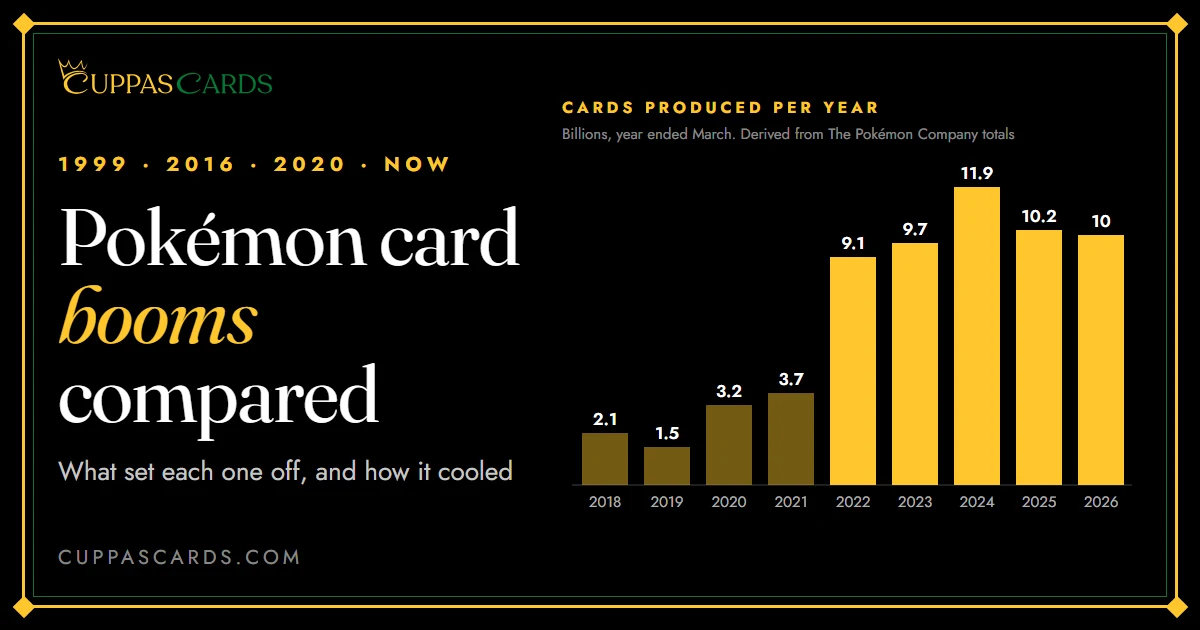
The Pokémon Company answered with much bigger print runs. About 9 billion cards were printed from March 2021 to March 2022, up from 3.7 billion the year before (Fortune, July 2022).
PokeGuardian (May 2026) tracks The Pokémon Company's running production total for each year ending in March. PokeGuardian reports the yearly figures for 2022 to 2025. We worked out the others by subtracting one total from the next, so those are marked "about". The source gives both 64.8 and 64.9 billion for March 2024. These are cards produced, not cards sold.
| Year ended March | Total produced to date (billions) | Produced that year (billions) |
|---|---|---|
| 2018 | 25.7 | about 2.1 |
| 2019 | 27.2 | about 1.5 |
| 2020 | 30.4 | about 3.2 |
| 2021 | 34.1 | about 3.7 |
| 2022 | 43.2 | 9.1 |
| 2023 | 52.9 | 9.7 |
| 2024 | 64.8 to 64.9 | 11.9 |
| 2025 | 75 | 10.2 |
| 2026 | 85 | about 10 |
Yearly production more than doubled between 2021 and 2022. It has stayed between about 9 and 12 billion cards a year ever since.
How did the 2020-22 boom cool off?
More cards meant cheaper common cards. By July 2022, Fortune reported that commons had dropped from about 6 cents to 1 cent each. That's roughly R1 down to 16 cents (Fortune, July 2022).
What happened to PSA grading in 2021?
On 30 March 2021, PSA suspended its Value, Regular and Express tiers, which cost US$20 to US$150 a card (about R330 to R2,460). For grading, only the US$300 tier (about R4,920) stayed open, for cards worth US$2,500 (about R41,000) or more (Pre-War Cards, April 2021).
Submissions had topped 500,000 a week in early 2021 (SCD, June 2022). The backlog peaked at 13 to 14 million cards, by SCD's December 2021 report, and waits ran nine months to a year (SCD, December 2021). A later SCD report put the peak at more than 12 million.
Regular service came back in December 2021 at US$100 a card (about R1,640) (SCD, December 2021). The Value tier reopened on 9 June 2022 (SCD, June 2022). Even so, Fortune still described grading waits of at least 10 months in July 2022.
Is 2025-26 a fourth Pokémon card boom?
It has many of the same signs, and grading demand is at record levels. PSA graded nearly 20 million items in 2025, the biggest year in its history. More than 11 million were TCG cards, mostly Pokémon (SI, January 2026).
The queue overflowed again in 2026. From 2 June 2026, PSA paused its Value Bulk, Value, Value Plus and Value Max tiers. Its backlog had jumped 20% to nearly 10 million submissions (SCD, May 2026).
This backlog looks different from 2021's, though. PSA's output was at an all-time high, five times its 2021 level. Regular turnaround was 40 to 50 days, according to the same report.
On 16 February 2026, Logan Paul's PSA 10 Pikachu Illustrator sold at Goldin for US$16,492,000 (about R271 million). That set a Guinness World Record. He'd bought it privately earlier for US$5,275,000, about R86.6 million (Guinness World Records, February 2026).
About 10 billion cards were produced in the year to March 2026, by the PokeGuardian figures above. 30th Celebration came out on 16 September 2026, and our 30th Celebration pull rates guide covers what's in the packs.
So is it a fourth boom? On grading volume alone, it's bigger than 2021. What nobody can tell you is when or how it cools. The 1999 and 2020-22 booms both cooled in the end, and no price is guaranteed. This isn't investment advice.
What does a boom mean for grading turnaround?
A backlog is simple maths. When more cards arrive than a grader can finish, the queue grows, and every new card waits behind it.
Both PSA backlogs followed a similar pattern. Demand jumped, the cheaper tiers paused, and pricier tiers stayed open. In 2021, waits for most collectors stretched to nine months to a year.
If you're planning to grade during a boom, here's what we'd suggest:
- Check a grader's current turnaround before you send, not last year's figure.
- Expect the cheapest tiers to fill up or pause first.
- Count the whole trip from South Africa: shipping, customs and the grader's own queue.
Different graders run different queues. PCG and PSA are separate companies, so PSA's backlog isn't PCG's queue. Our PCG vs PSA comparison sets the two side by side. If PCG is new to you, start with what PCG grading is.
FAQ
When was the first Pokémon card boom?
It was 1999 in the US. More than 400,000 packs sold in six weeks, about ten times Wizards of the Coast's forecast, and some schools banned or restricted the cards. By early 2001, Hasbro partly blamed falling sales of Pokémon toys and cards for a big drop in its games revenue.
Did the 2020-22 boom end?
Parts of it cooled. Common card prices fell sharply by mid-2022, and PSA reopened its Value tier in June 2022. But production stayed around 10 billion cards a year, and grading hit a record in 2025, and PSA's backlog jumped again in 2026.
Does a PSA backlog slow down PCG grading?
They're separate companies with separate queues. Turnaround changes over time, so ask us for the current PCG figure before you submit. Our guide on how to get Pokémon cards graded in South Africa walks through the full process.
Ready to send cards to PCG? Start your submission here.