9 Card Grading Mistakes That Cost You a Grade or Money
By Mitchell Taljaard ·
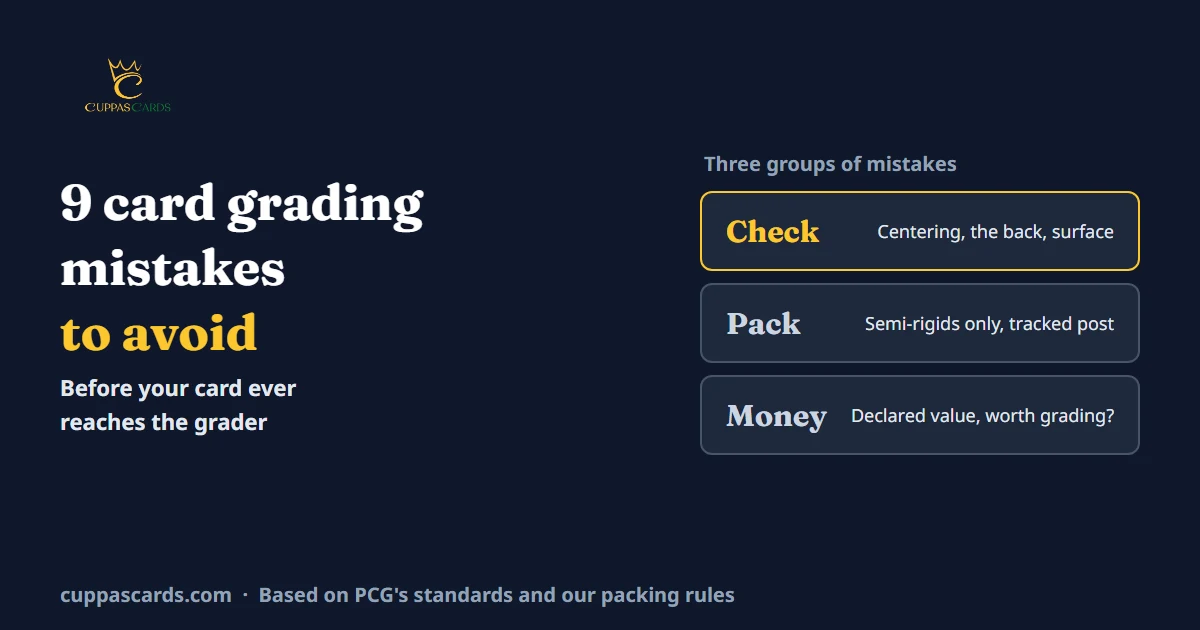
The mistakes below all happen before the card reaches the grader. Some cost you a grade you expected. Others cost you money, either in fees you didn't need to pay or in a card that wasn't worth grading.
We're Cuppas Cards, and we send South African cards to PCG (Premier Card Grading) in the UK. We don't grade cards ourselves: PCG assigns every grade. Each mistake below links to PCG's standards or our own rules, so you can check the detail.
The nine mistakes at a glance
| Mistake | What it can cost you | How to avoid it |
|---|---|---|
| 1. Judging centering by eye | A lower grade than you expected | Measure the borders on a zoomed photo |
| 2. Forgetting the back | A lower grade than you expected | Check the back first |
| 3. Checking under straight light | Missed surface flaws | Tilt the card under a bright light |
| 4. Ignoring one tiny flaw | A Pristine 10 instead of a Flawless 10 | Set expectations from what you find |
| 5. Cleaning or "fixing" a card | An Altered label | Only wipe off dust, dry |
| 6. Toploaders, tight sleeves, tape | An R50 re-sleeve fee per card | Penny sleeve plus semi-rigid saver |
| 7. Untracked post | A lost parcel you can't trace | Use a tracked courier |
| 8. Under-declaring value | A smaller payout if a card is lost | Declare the raw value honestly |
| 9. Grading low-value cards | Paying more than the slab adds | Compare raw and graded prices first |
Mistakes when checking the card
1. Judging centering by eye
A card that looks centred at arm's length can still be off. Grades have centering limits, and a small difference matters.
PCG's Mint 9 needs front centering of 55/45 or better (PCG grading standards). A card at 60/40 is already outside that, whatever its corners look like.
How to avoid it: measure the borders. Take a straight-on, zoomed photo and compare the border widths on screen, left to right and top to bottom. Our pre-grading checklist shows how to turn the measurements into a ratio.
2. Forgetting the back of the card
Graders check the back as well as the front. Centering, corners and edges on the back all count.
PCG's Flawless 10 needs 50/50 centering on the back as well as the front. Its Pristine 10 and Gem Mint 10 allow up to 60/40 on the back (PCG grading standards). PSA's Gem Mint 10 allows up to about 75/25 on the back (PSA grading standards).
How to avoid it: check the back first, under the same light and magnification as the front. Look closely at the back edges and corners for white flecks.
3. Checking for flaws under straight light
Our pre-grading checklist says to tilt every card under a bright light. Many surface flaws, such as fine scratches, print lines and small dents, only show at an angle.
How to avoid it: hold the card under a bright light and tilt it slowly in different directions. Take photos at an angle too. Our pre-grading checklist lists what to look for.
4. Assuming one tiny flaw won't matter
At the top of the scale, one small flaw can be the whole difference. PCG has three levels of 10, and they're separated by how many subgrades show any flaw at all.
Flawless 10 needs a perfect 10 on all four subgrades. Pristine 10 allows one minor imperfection, and Gem Mint 10 allows minor imperfections in two subgrades (PCG grading standards).
How to avoid it: set your expectations from what you find. With 50/50 centering, a single white fleck on one corner can still reach a Pristine 10, but not a Flawless 10. Our guide to PCG grades explains each level.
5. Cleaning or "fixing" a card
Trying to improve a card can earn it an Altered label instead of a clean grade. If PCG finds a card has been modified, it labels it "Altered" (PCG grading standards). PSA and CGC give altered cards an Altered Authentic or Authentic Altered label instead of a number (PSA grading standards, CGC grading scale). Our guide to what card grades mean explains these labels.
How to avoid it: at most, wipe off dust or a fingerprint with a dry, soft microfibre cloth, using gentle strokes. Don't use water, cleaning sprays or pressure. Our guide to cleaning cards before grading covers what counts as alteration.
Mistakes when packing and posting
6. Using toploaders, tight sleeves, tape or rubber bands
Every card must arrive in a clear, loose-fit penny sleeve inside a semi-rigid card saver. Cards that arrive loose, in toploaders or badly protected are re-sleeved for R50 per card before we process them. That fee is added to your return delivery bill.
Our packing rules also ban tight or coloured sleeves and tape on the card savers. They also ban rubber bands wrapped tightly around the cards, which can permanently dent card edges.
How to avoid it: follow our guide to packing cards for grading step by step. Each card goes in a penny sleeve, then a semi-rigid card saver with a pull-tab.
7. Sending cards by untracked post
Our shipping guide says to avoid the standard post office and use a tracked courier, such as Pudo or The Courier Guy.
Your post to us also isn't covered by our DHL insurance. That cover is for the two international legs only: us to PCG, and PCG back to us.
How to avoid it: send your box tracked and keep the tracking number until your dashboard shows your cards have arrived. In Cape Town, you can hand your cards over at our booth at collector shows instead.
Mistakes with the money
8. Under-declaring a card's value
Your declared value sets two things: the insurance you pay and the amount any claim pays out. Insurance through us costs 3% of the declared value (our insurance terms).
So declaring a R1,000 card at R200 saves R24 in insurance. If the card is lost, the payout is based on R200.
How to avoid it: declare what the card is worth raw today, as close as you can tell. Our step-by-step grading guide explains how declared value works.
9. Grading cards worth less than the grading cost
Grading only adds value when the slab is likely to be worth more than the card plus the cost of grading it. Through us, that cost is R495 per card, including PCG's £15 grading fee and the UK round trip. Customs, VAT and insurance are added at checkout, so a card declared at R1,000 comes to R623. That's before postage to us (about R70 by Pudo) and delivery back (from R60).
How to avoid it: check what the card sells for raw, and what it sells for graded, before you send it. Our cost breakdown has worked examples. For a valuable card you plan to sell, our PSA resale guide covers when a pricier grader pays off.
Frequently asked questions
What is the most common reason a card misses a 10?
We don't know of a published figure for that. What PCG's standards do show is how little it takes: Flawless 10 needs perfect subgrades, and Mint 9 needs front centering of 55/45 or better.
Will cleaning a card improve its grade?
It can do the opposite. If PCG finds a card has been modified, it labels it "Altered". Only wipe off dust with a dry microfibre cloth.
Can I send my cards in toploaders?
No. Every card must be in a semi-rigid card saver. Cards that arrive in toploaders are re-sleeved for R50 per card.
Before you send your cards
Run through our pre-grading checklist and packing guide, then submit your cards for PCG grading.