Pokémon TCG History: 30 Years From 1996 to 2026
By Mitchell Taljaard ·
The Pokémon Trading Card Game turned 30 on 20 October 2026. That's three decades of booster packs, reprints and big milestones. This post walks through the big moments, from a Japanese starter deck to the 30th Celebration set.
We're Cuppas Cards, a PCG submission service for South African Pokémon collectors. We don't grade cards ourselves: PCG (Premier Card Grading) in the UK assigns every grade.
When did the Pokémon TCG start?
The Pokémon TCG started in Japan on 20 October 1996. Media Factory published it, and the first starter deck and expansion pack came out that day (Wikipedia, Pokémon Trading Card Game).
The Pokémon video games came out in Japan earlier in 1996. So the card game is slightly younger than the franchise itself. That's why you'll see "30 years of Pokémon" celebrated before the TCG's own birthday in October.
How did the Pokémon TCG reach English players?
English players had to wait more than two years. Wizards of the Coast started publishing the game in the US towards the end of 1998. The English Base Set followed on 9 January 1999 (Wikipedia, Pokémon Trading Card Game; Wikipedia, List of Pokémon TCG sets).
The cards were a hit fast. In September 1999, Hasbro bought Wizards of the Coast for US$325 million, based on the strength of the Pokémon licence (Wikipedia, citing Shannon Appelcline's Designers & Dragons).
How did the Pokémon TCG move from Wizards to The Pokémon Company?
The public record shows the steps, not the full reasons. Here's the sequence, as Wikipedia reports it (Wikipedia, Pokémon Trading Card Game):
- 2001: Nintendo created Pokémon USA.
- Mid-2003: Publishing rights moved from Wizards of the Coast to The Pokémon Company.
- 1 October 2003: Wizards sued Nintendo.
- Later: The two sides settled out of court.
In plain terms, the company behind Pokémon brought the card game in-house. Wizards had been a licensed publisher, and that arrangement ended. Our sources don't give the settlement terms, so we won't guess at them.
For collectors, this split matters. English cards from 1999 to mid-2003 are often called "WotC era" cards. Everything after was published by The Pokémon Company. Our guide to Wizards of the Coast era cards covers every set from those years.
What are the Pokémon TCG eras? A timeline from Base Set to Mega Evolution
Each era below starts with its first main English expansion. The table covers the main eras and skips a few series that our source list doesn't date, such as HeartGold & SoulSilver. The dates below come from Wikipedia's list of Pokémon TCG sets.
| Era | First English set | Release date |
|---|---|---|
| Base | Base Set | 9 January 1999 |
| Neo | Neo Genesis | December 2000 |
| Legendary Collection | Legendary Collection | May 2002 |
| e-Card | Expedition | September 2002 |
| EX | EX Ruby & Sapphire | 18 June 2003 |
| Diamond & Pearl | Diamond & Pearl | May 2007 |
| Platinum | Platinum | 11 February 2009 |
| Black & White | Black & White | April 2011 |
| XY | XY (Kalos Starter Set came first, 8 November 2013) | 5 February 2014 |
| Sun & Moon | Sun & Moon | 3 February 2017 |
| Sword & Shield | Sword & Shield | 7 February 2020 |
| Scarlet & Violet | Scarlet & Violet | 31 March 2023 |
| Mega Evolution | Mega Evolution | 26 September 2025 |
The first four eras all landed during the Wizards years. The EX era began in June 2003, right around the handover.
The Scarlet & Violet era closed with two sets, Black Bolt and White Flare, on 18 July 2025. Mega Evolution started about two months later (Wikipedia, List of Pokémon TCG sets).
How many Pokémon cards have been made?
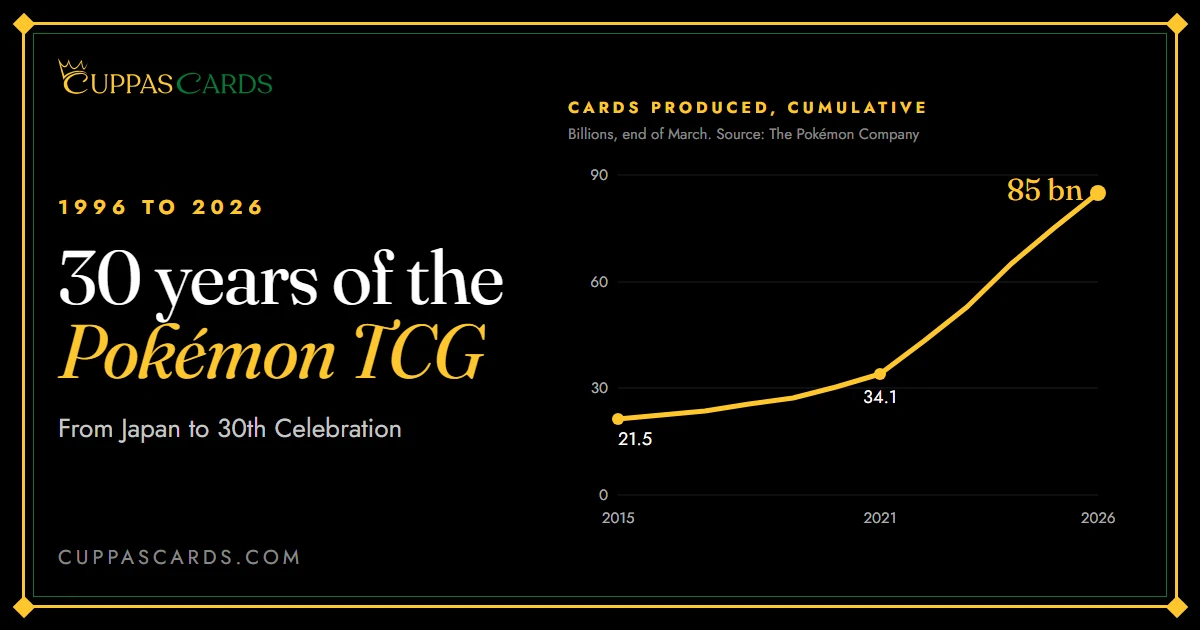
More than 85 billion Pokémon cards had been produced by the end of March 2026. About 10 billion of those came in the 2025/26 financial year alone (PokeGuardian, May 2026).
The Pokémon Company reports cards produced, not cards sold. Those aren't the same thing, so be careful with headlines that say "sold".
Here's how the running total grew. Each figure is cumulative, at the end of March. There's no published figure for 2016 in our sources.
| End of March | Cumulative cards produced (billions) |
|---|---|
| 2015 | 21.5 |
| 2017 | 23.6 |
| 2018 | 25.7 |
| 2019 | 27.2 |
| 2020 | 30.4 |
| 2021 | 34.1 |
| 2022 | 43.2 |
| 2023 | 52.9 |
| 2024 | 64.9 |
| 2025 | 75 |
| 2026 | 85 |
Sources: The Pokémon Company's Pokémon in Figures page, which shows the current total. The year-by-year totals were compiled by PokeGuardian (May 2026) from the same company figures.
Between 2015 and 2020, the total grew by about 9 billion cards. Between 2020 and 2026, it grew by about 55 billion. That's more cards in six years than in the game's first 23 years or so combined. We compare the demand behind it in Pokémon card booms compared.
Celebrations, Classic and Pocket: what are the modern milestones?
The last five years brought three big moments: a set, a premium box and an app.
Celebrations (2021)
Celebrations marked the TCG's 25th anniversary. It came out on 8 October 2021 (Wikipedia, List of Pokémon TCG sets). Its Classic Collection reprinted famous older cards, such as Base Set Charizard.
Don't mix it up with 30th Celebration. "Celebrations" is the 2021 set. "30th Celebration" is the 2026 one.
Pokémon TCG Classic (2023)
Pokémon TCG Classic came out on 17 November 2023. The box held three 60-card decks, each led by a recreated Base Set card: Venusaur, Charizard and Blastoise (The Pokémon Company press release, September 2023).
Pokémon TCG Pocket (2024)
Pokémon TCG Pocket brought card collecting to phones. It was announced on 27 February 2024 and released worldwide on 30 October 2024 (Wikipedia, Pokémon Trading Card Game).
What's special about 30th Celebration (2026)?
30th Celebration came out on 16 September 2026. It's the first expansion with a coordinated, simultaneous global launch (The Pokémon Company press release, June 2026).
The press release lists these features:
- Every card is foil.
- 30 classic reprints of cards from the game's history.
- 30 Pikachu cards by 30 different artists, with one in each pack.
- A new "Futuristic rare" rarity, designed by YOSHIROTTEN.
For South African collectors, a global launch is a nice change of pace. Back in the 1990s, English players waited more than two years after Japan. This time, the idea was one release date for everyone.
If you're chasing the big cards, see our 30th Celebration pull rates breakdown. We've also looked at whether the 30th Celebration Charizard reprint is worth grading.
How big is card grading now?
Grading has become a big part of the hobby. PSA called 2025 its biggest grading year ever, with nearly 20 million items graded (Sports Illustrated, January 2026).
More than 11 million of those were TCG cards, and most were Pokémon. That's a lot of slabs, and it shows how many collectors now want their cards checked and sealed by a third party.
Is it worth grading old cards versus new ones?
It depends on the card, not the era. Old or new, a grade comes down to condition. No one can promise a grade, and grading is never a sure bet on value.
Before you send anything, give each card a careful look. Our guide on how to check a card before grading walks you through what to look for. If you're unsure what the numbers mean, read what card grades mean from 1 to 10.
If you collect Japanese cards too, we compare the two in grading Japanese vs English Pokémon cards.
FAQ
Is the Pokémon TCG 30 years old in 2026?
Yes. The TCG launched in Japan on 20 October 1996, so it turned 30 on 20 October 2026 (Wikipedia). The video games came out earlier in 1996, which is why franchise celebrations started sooner in the year.
When did English Pokémon cards come out?
The English Base Set was released on 9 January 1999. Wizards of the Coast published it (Wikipedia, List of Pokémon TCG sets).
Who publishes the Pokémon TCG now?
The Pokémon Company. It took over publishing from Wizards of the Coast in mid-2003 (Wikipedia).
Have 85 billion Pokémon cards been sold?
Not quite. The 85 billion figure counts cards produced by the end of March 2026, not cards sold (PokeGuardian).
Got a card from any of these eras you'd like graded? Start a PCG submission from South Africa.