PCG vs TAG Grading for Pokémon Cards: Which Suits SA?
By Mitchell Taljaard · · Updated
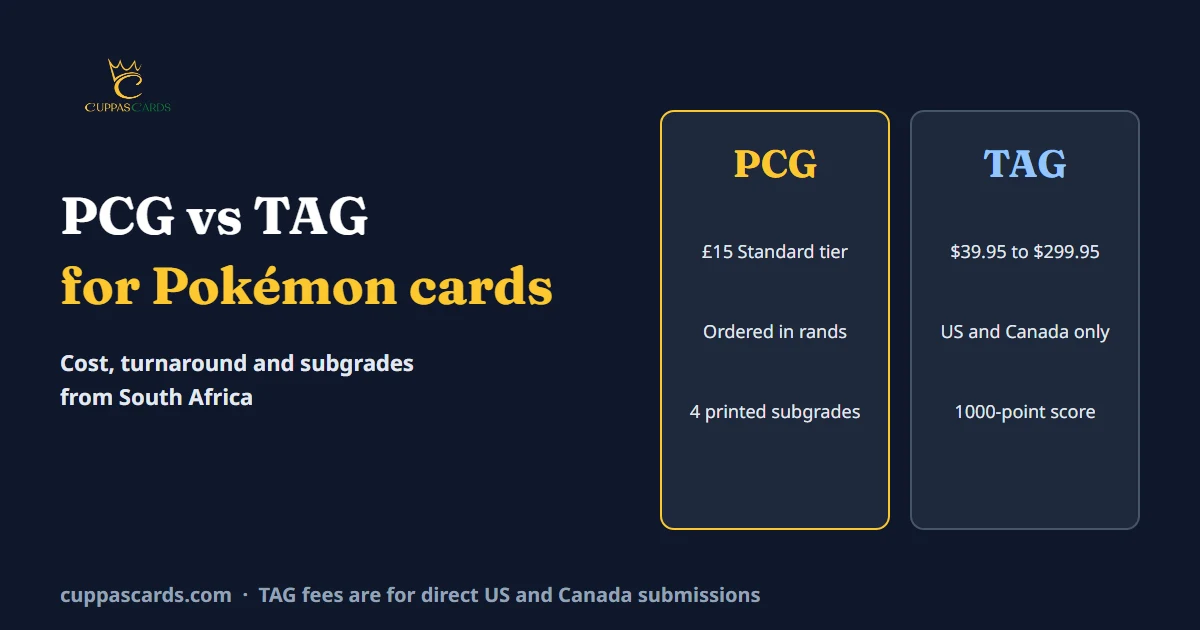
TAG (Technical Authentication & Grading) is the newer grader collectors bring up when they want something more precise than a single number. On its Standard tier and above, it scores each card out of 1000 and publishes an online report with eight subgrades.
We're Cuppas Cards, a PCG submission service for South African Pokémon collectors. We don't grade cards ourselves: PCG assigns every grade. So we have a side in this. Below, we've used each grader's own published figures, plus the turnaround PCG has promised our batches, all checked on 19 October 2026.
PCG vs TAG at a glance
| PCG (through Cuppas Cards) | TAG (direct, US and Canada) | |
|---|---|---|
| Cheapest grading fee | £15 Standard, R325 | $39.95 Base (5-card minimum, grade only), about R658 |
| Fee with a score or subgrades | £15 Standard, R325 | $59.95 Standard, about R987 |
| Grading time | About 30 days promised for our partner batches, not yet tested (4 to 6 weeks direct) | 60 business days Base, 45 Standard, 30 Priority |
| Top grade | Flawless 10, then Pristine 10 and Gem Mint 10 | Pristine 10, then Gem Mint 10 and Mint 10 |
| Subgrades | Four, printed on the Standard label | Eight, in the online report on Standard and above |
| Ordering from SA | UK leg included (R170 DHL share); postage to us extra | No direct orders; only through TAG's partners abroad |
Dollar figures are converted at R16.46 to the dollar (Trading Economics, 19 October 2026). PCG's R325 is our quoted rand price for its £15 fee. TAG's fees, turnarounds and minimums come from its pricing page. PCG's come from PCG UK's pricing page.
Can you send cards to TAG from South Africa?
Not directly. TAG says it only accepts direct customer orders from the United States and Canada. Everyone else has to go through one of its authorised partners, which TAG lists for Canada, the United Kingdom, Australia and Hong Kong (TAG help centre, updated June 2026).
TAG also says it doesn't recommend sending cards to its facility from outside the United States. Parcels that arrive with duties or taxes for TAG to pay may be rejected and returned. Its two UK partners are The SubCenter and Grade With TAG (TAG help centre). If you want to try TAG from South Africa, first ask a partner whether it accepts cards from here. Ask what it charges on top of TAG's fee, too.
PCG through Cuppas Cards is set up for South Africa. You order online, pay in rands, and post your cards to us or drop them off at our booth at Cape Town shows.
Which is cheaper from South Africa, PCG or TAG?
PCG, by a wide margin. TAG's Base tier alone costs more than our full PCG service price.
PCG through Cuppas Cards costs R495 per card, including the £15 grading fee and the DHL trip to the UK and back. Customs, VAT and insurance are added at checkout, so a card declared at R1,000 comes to R623. Your postage to us and local delivery back are extra.
TAG's $39.95 Base tier is its cheapest open tier, since its Value and Bulk services are paused. It's about R658 per card and needs at least 5 cards. If the returned slabs face the same estimated 20% duty and 15% VAT we use, that adds about R230, so budget about R888 a card. That's our estimate, and it's before a partner's fees and shipping to the partner and back. TAG's Standard tier, the cheapest one with its 1000-point score, is $59.95, about R987 before any of those costs.
TAG does include protection on every tier: up to $500 a card on Base and $1,000 on Standard (TAG pricing). Our cost breakdown shows every rand of the PCG route.
Which is faster, PCG or TAG?
Unless you pay for TAG's $149.95 Express tier or above, PCG. TAG quotes 60 business days for Base, 45 for Standard and 30 for Priority at $79.95 (TAG pricing). That's roughly three months, two months and six weeks. Its faster tiers cost $149.95 for 10 business days and $299.95 for 3 to 5.
PCG UK quotes 4 to 6 weeks on its £15 Standard tier for direct submissions (PCG UK pricing). As a PCG partner, our batches are promised about 30 days at PCG. From South Africa, we expect slabs back about 40 days after a batch ships, though our first batch is still out.
TAG says its turnaround times are estimates and not guaranteed. It counts business days from when its receiving team logs your order, not from when you post it (TAG help centre).
How do PCG and TAG grades compare?
Both give a 1 to 10 grade, but TAG works it out from a score out of 1000.
TAG's Gem Mint 10 needs a score of 990 to 1000, and a score of 950 to 989 is a Mint 10. TAG uses half grades everywhere except between 9 and 10, so there's no 9.5 (TAG grading scale). Above Gem Mint sits the TAG Pristine 10, which TAG says represents less than 1% of the cards it grades. For Pokémon and other TCG cards, it generally needs front centering no worse than 51/49 and back centering no worse than 52/48 (TAG help centre).
PCG splits its 10s into Flawless 10, Pristine 10 and Gem Mint 10. Flawless 10 needs a perfect 10 on all four subgrades. Pristine 10 allows one minor imperfection, and Gem Mint 10 allows minor imperfections in two subgrades (PCG grading standards). PCG also uses 9.5. Our guide to PCG grades explains each one.
TAG's imaging software finds the flaws, and TAG says people check every flaw it flags before the grade is set (TAG help centre).
Does PCG or TAG give subgrades?
Both do, in different places.
PCG prints four subgrades on every Standard-tier label: centering, corners, edges and surface. You can read them by looking at the slab.
TAG's report gives eight subgrades: front and back for centering, corners, surface and edges. They come only on tiers that include the TAG Score, which means Standard and above. The report is online, and you open it by scanning the QR code on the slab. TAG's Base tier gives a grade with a shorter report and no subgrades (TAG help centre).
Do PCG or TAG slabs sell for more?
We don't know yet, and we haven't found reliable public sales data comparing the two.
If you're grading a valuable card mainly to sell it, check recent sold prices for that card in TAG and PCG slabs before you choose. Our PCG vs PSA guide covers the resale question for the best-known grader.
Should you choose PCG or TAG?
Choose PCG through Cuppas Cards if:
- You live in South Africa and want one rand price that covers the grading fee and the trip to the grader and back
- You want subgrades printed on the slab itself
- You want slabs back in weeks, not months, without paying for a fast tier
- You're sending one card or a few
Choose TAG if:
- You can reach one of TAG's partners and it accepts your cards
- You want a 1000-point score and a detailed online report of every flaw
- You're happy to pay more per card for that report
Comparing other graders too? Our PCG vs CGC comparison and PCG vs Beckett comparison cover two more. For all five graders side by side, see our guide to choosing a card grading company from South Africa.
Frequently Asked Questions
Does TAG accept South African submissions?
Not directly. TAG takes direct orders only from the US and Canada, and points everyone else to partners in Canada, the UK, Australia and Hong Kong. Ask a partner whether it accepts cards from South Africa before you send anything.
Is TAG grading done by AI?
TAG says it uses machine-learning imaging software to find flaws, and that people check every flaw it flags before setting the grade (TAG help centre).
Does TAG grade Japanese Pokémon cards?
Yes. TAG accepts English, Japanese and Chinese Pokémon cards, but not Korean, French, German, Italian, Spanish or Portuguese ones (TAG eligibility). Our Japanese vs English grading guide covers what changes for Japanese cards.
Can Cuppas Cards send my cards to TAG?
No. We only send cards to PCG in the UK.
Before you send your cards
Read our step-by-step grading guide and our shipping and packing guide. Pack every card in a semi-rigid holder, then add your cards on our submission page. One card per order is fine.
TAG and PCG figures as published on 19 October 2026.