Pokémon Card Artists: The Illustrators Collectors Chase
By Mitchell Taljaard · · Updated
Lots of collectors now chase an artist, not just a Pokémon. This guide covers who draws the cards, the names collectors hunt for, and what their best-known cards cost.
We're Cuppas Cards, a PCG submission service for South African Pokémon collectors. We don't grade cards ourselves: PCG (Premier Card Grading) in the UK assigns every grade. All prices are as of 21 October 2026. Card details, artist credits and prices come from the pokemontcg.io card database, which carries TCGplayer market prices (last updated 15 October 2026). Rand figures use R16.41 per US$ (Trading Economics, 20 October 2026).
Who draws Pokémon cards?
Pokémon cards are drawn by many different illustrators, not one in-house artist. Some have worked on the game since the very start. Others joined with newer sets, and contest winners can see their art printed as promos.
Mitsuhiro Arita is a good example of how the work happens. He's drawn for the TCG since the first Japanese cards in 1996, yet he's not a full-time Creatures Inc. employee (Pokémon.com Creator Profile, July 2018). Each of his illustrations takes about seven weeks. It moves from rough sketch to line art to colour, with an approval at every stage.
The artist mix is now part of how sets are sold. The 2026 30th Celebration set includes 30 Pikachu cards by 30 different artists, one in each pack (Game Informer, October 2026). Our 30th Celebration pull rates guide covers what else is in those packs.
Which Pokémon card artists do collectors chase?
These are some of the best-known names behind the cards. We've stuck to facts we can source, so some entries are short.
Mitsuhiro Arita
Arita is the name most collectors know first. He illustrated Base Set Charizard 4/102, Pikachu 58, Venusaur 15 and Gyarados 6. He's put art on more than 500 cards, and his own binder holds 537 of them (Pokémon.com Creator Profile, July 2018). Base Set Charizard and Pikachu sit on page one.
Atsuko Nishida
Nishida drew Pikachu's original design, and it was based on a squirrel, not a mouse. She said so in a 2018 Yomiuri interview (Kotaku). Ken Sugimori then finalised Pikachu's look. Nishida is also credited on the Pikachu Illustrator, the most expensive Pokémon card ever sold at auction (more on that below).
Ken Sugimori
Sugimori is the Pokémon series' lead designer, so his work shapes the whole franchise. On the card side, he illustrated Base Set Blastoise 2 and Mewtwo 10. Those two sit alongside Arita's Charizard and Venusaur in the original set's holo run.
Kagemaru Himeno
Himeno paints in watercolour, which gives her cards a soft, storybook feel. Her first TCG art appeared in the Japanese Jungle set in 1997. She's best known for the Jungle Eeveelutions and a fan-run card database lists more than 600 of her cards (Dittobase).
Yuka Morii
Morii works in clay rather than paint. She pictures each Pokémon in 3D and sketches it, then shapes the model by hand, as she explains in a Scrmbl interview. Her first TCG work appeared in the Neo Discovery set in 2000, as that interview notes. If a card looks like a tiny 3D model, check the name at the bottom.
KEIICHIRO ITO
ITO drew the Umbreon VMAX alt art from Evolving Skies, 215/203. Collectors call it "Moonbreon". An alt art is an alternate-art version with a full scene instead of the standard layout. It's the priciest raw card in our table below. The card itself prints KEIICHIRO ITO.
sowsow
sowsow drew the Gengar VMAX alt art from Fusion Strike, 271/264. It's one of three modern alt arts in our table that sell for over US$1,000 raw.
Shinji Kanda
Kanda is a fun one, because he drew two very different chase cards. One is the Giratina V alt art from Lost Origin, 186/196. The other is the Magikarp Illustration Rare from Paldea Evolved, 203/193. Both sell for hundreds of US dollars raw.
How much do chase cards by these artists cost?
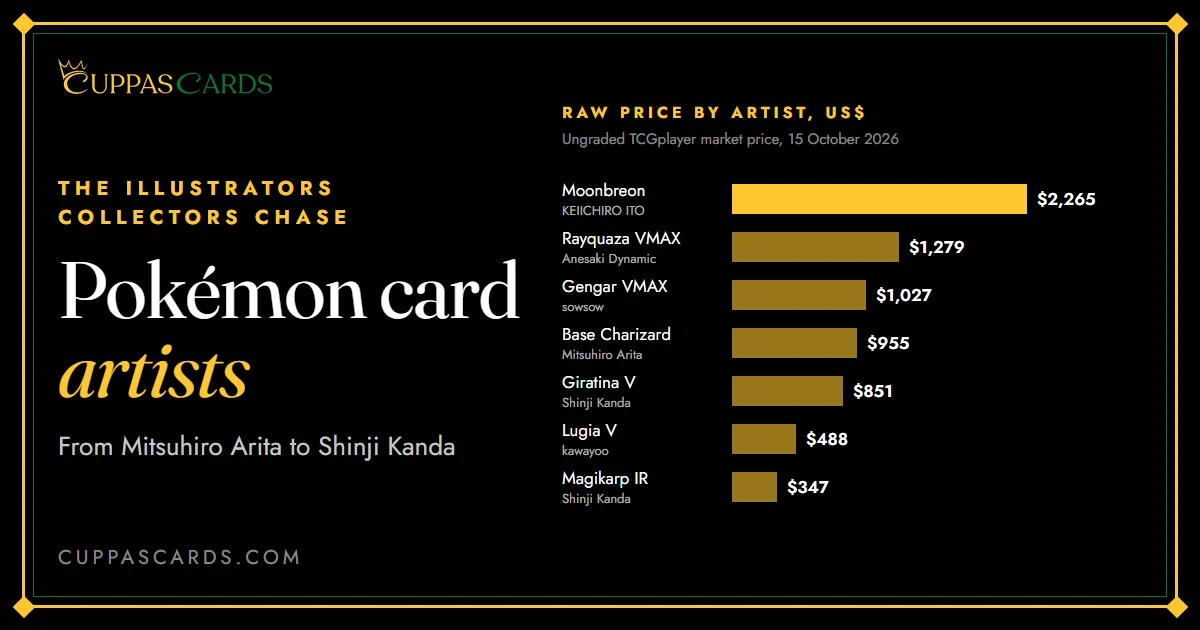
Here are raw (ungraded) TCGplayer market prices for well-known chase cards, sorted by price, with the artist on each row. These are US market prices, so local sale prices can differ. The database doesn't say which print run or condition the Base Set Charizard price covers.
| Card | Set and number | Artist | Year | Raw price (USD) | About (ZAR) |
|---|---|---|---|---|---|
| Umbreon VMAX alt art ("Moonbreon") | Evolving Skies 215/203 | KEIICHIRO ITO | 2021 | $2,264.70 | R37,160 |
| Rayquaza VMAX alt art | Evolving Skies 218/203 | Anesaki Dynamic | 2021 | $1,278.52 | R20,980 |
| Gengar VMAX alt art | Fusion Strike 271/264 | sowsow | 2021 | $1,027.32 | R16,860 |
| Charizard | Base Set 4/102 | Mitsuhiro Arita | 1999 | $954.65 | R15,670 |
| Giratina V alt art | Lost Origin 186/196 | Shinji Kanda | 2022 | $851.13 | R13,970 |
| Lugia V alt art | Silver Tempest 186/195 | kawayoo | 2022 | $488.36 | R8,010 |
| Magikarp Illustration Rare | Paldea Evolved 203/193 | Shinji Kanda | 2023 | $346.95 | R5,690 |
| Espeon VMAX alt art | Fusion Strike 270/264 | Kouki Saitou | 2021 | $341.35 | R5,600 |
| Charizard ex Special Illustration Rare | 151 199/165 | miki kudo | 2023 | $323.37 | R5,310 |
| Iono Special Illustration Rare | Paldea Evolved 269/193 | kirisAki | 2023 | $46.85 | R770 |
Source: TCGplayer market prices, 15 October 2026. Rand at R16.41 per US$.
The two most valuable raw cards are both 2021 alt arts, not vintage cards. Shinji Kanda appears twice. And even an art-led Special Illustration Rare like Iono can sell for far less than the cards around it.
How did Illustration Rares put artists centre stage?
The 2021 alt arts in our table had already made the art the selling point. Since then, full-scene art has moved further into the spotlight.
Another big step came with Brilliant Stars, released in English on 25 February 2022. It added a 30-card Trainer Gallery subset, numbered separately from the main set (Wikipedia). These cards show Pokémon alongside their trainers in scene-style art.
Then Scarlet & Violet, the first English set of that era, launched on 31 March 2023 (Wikipedia). It introduced two new rarity tiers, Illustration Rare and Special Illustration Rare (Pokémon.com).
That's why cards like Kanda's Magikarp get chased. The art is the point of the card, so collectors start following who made it.
What is the Pikachu Illustrator card?
The Pikachu Illustrator is a 1998 prize card that was never sold in shops. It was given out in a 1998 illustration contest, and it's credited to Atsuko Nishida (Guinness World Records, February 2026).
Logan Paul's PSA 10 copy sold at Goldin on 16 February 2026. The price was $16,492,000 including buyer's premium, about R271 million at today's exchange rate. Guinness confirmed it as the most expensive Pokémon card ever sold at auction. That's a 2026 sale, not a current value for any other copy.
Paul says 39 copies were given out. He bought his card privately in 2021 for $5,275,000 (about R86.6 million at today's rate). That deal was a PSA 9 Illustrator plus $4 million cash (Guinness World Records, February 2026).
Illustration contests still run
The contest idea is still alive. The Pokémon TCG Illustration Contest 2024 ran from October 2023 to January 2024 under the theme "Magical Pokémon Moments" (Pokémon press release, September 2024). It drew over 10,000 entries.
Official TCG illustrators judged the entries. Kazuki Minami won the Grand Prize with a Pikachu piece and took home $5,000 (about R82,000 at today's rate). The winning art becomes promo cards, so new artists can still break into the game this way.
How do you find out who drew a Pokémon card?
Look at the bottom left of the card. The illustrator's name is printed there in small text. It's on vintage cards, modern alt arts and promos alike.
It pays to check the card rather than trust a listing or guide. Listings can get credits wrong, and the printed name is the one that counts.
Can you grade a signed Pokémon card?
Yes, at some graders. Artist signatures are popular, and PSA has offered dual grading for autographed cards since 2016 (Sports Collectors Digest, January 2016). PSA first authenticates the autograph. It then grades the card and the autograph separately, each on a 1 to 10 scale, and prints both on the label.
We haven't confirmed how PCG handles autographed cards. If you have a signed card, please ask us before you send it. We'd rather check first than have it come back with a surprise.
Be careful buying signed cards, too. Fake artist signatures exist, and a signature adds nothing if it can't be trusted. Buy from sellers you know, and treat an unverified autograph with caution.
Is an artist chase card worth grading?
It can be, but only if the card is in strong shape. A famous artist doesn't protect a card from centring, whitening or surface scratches. Graders look at condition, not at who drew it.
Before you decide, run through how to check a card before grading. Then read what card grades mean from 1 to 10 so you know what each grade says. If your copy is a Japanese print, see grading Japanese vs English cards.
From South Africa, PCG Standard grading through us is R593 per card plus 3% insurance (R495 service including PCG's £15 fee and DHL both ways, plus about R98 customs and VAT). That cost makes the most sense on cards worth well above it, like most of the table above. A low-value card may not justify it. We can't promise any grade or any return, and none of this is investment advice.
FAQ
Who drew the original Base Set Charizard?
Mitsuhiro Arita illustrated Base Set Charizard 4/102. He also drew Pikachu 58, Venusaur 15 and Gyarados 6 in the same set.
Who is the most collected Pokémon card artist?
There's no official ranking. Arita is the best-known vintage name, with art on more than 500 cards (Pokémon.com Creator Profile, July 2018). In our price table, KEIICHIRO ITO's Moonbreon is the most valuable raw card.
How is a signed card graded?
At PSA, the autograph is authenticated and gets its own 1 to 10 grade, printed next to the card grade (Sports Collectors Digest, January 2016). For PCG, ask us first, as we haven't confirmed its approach.
Got an artist chase card in great shape? Send it to PCG through us.